Great piece from the Manilla Bulletin on JP the Great and B XVI. Comments to follow.... (long, but worth it!)
I DON’T have to wait for international magazines like Time and Newsweek to tell the world what have been the most significant happenings of 2005. I am sure both Christians and non-Christians all over the world will agree that the death of Pope John Paul II and the election of Pope Benedict XVI have been the most momentous events during this year that is ending. The lives, actions, and words of these two intellectual giants will reverberate for many decades and centuries to come.
I couldn’t find a more fitting way to pay tribute to these two Popes who have inaugurated the Third Millennium than to share with my readers an interview that Pope Benedict XVI gave to the public television station in Poland last October 16, 2005, the day established by the Polish Parliament as Pope John Paul II Day to commemorate his election as Pope in 1978. The transcript of the interview appeared in the October 16, 2005 issue of Zenit International News Agency.
First, the present Pope talked about how his friendship with Cardinal Karol Wojtyla began: "I met him personally during the two pre-conclaves and conclaves of 1978. Naturally I had heard about Cardinal Wojtyla, especially in the context of correspondence between the Polish and German bishops in 1965. The German cardinals told me about the great merits and contribution of the cardinal of Krakow and how he was the soul of this historic correspondence. I had also heard from university friends about his stature as a philosopher and thinker. But, as I said, the first personal encounter took place during the conclave of 1978. I liked him from the beginning and, thanks to God, without any merit on my part, the then cardinal immediately made friends with me.
"I am grateful for this trust that he showed me. Above all, when I watched him pray, I saw and understood that he was a man of God. This was my first impression: A man who lives with God and in God. I was also impressed by the unprejudiced cordiality with which he made my acquaintance. On various occasions, he addressed these pre-conclave meetings of the cardinals, and it was here I had the opportunity to experience his stature as a thinker. Without using big words, he created a heartfelt relationship and immediately after his election as Pope, he called me to Rome several times for talks and in the end, he appointed me prefect of the Congregation for the Doctrine of the Faith."
These two Popes of modern times have a common lesson to teach all of us. What makes a man truly influential for good is not his intelligence or cunning. It is first and foremost a life of prayer. Prayer connects us to the omnipotent God who is the One who accomplishes any good we do. We are mere instruments. Pope John Paul II and now Pope Benedict XVI are examples of complete docility to the promptings of the Holy Spirit.
When asked what, in his opinion, are the most significant moments of the more than 25 years of John Paul II’s pontificate, Pope Benedict XVI replied: "We can see it (the Pontificate) from two perspectives: One (’ad extra’) – toward the world and the other (’ad intra’) – toward the Church. With regard to the world, it seems to me that through his speeches, his person, his presence, his capacity to convince, the Holy Father created a new sensitivity for moral values, for the importance of religion in the world. This has created a new opening, a new sensitivity towards religion and the need for a religious dimension in man. Above all, the importance of the Bishop of Rome has increased immensely.
"Despite the differences and despite their non-recognition of the Successor of Peter, all Christians have recognized that he is the spokesman of Christianity. No one else in the world, on an international level can speak in the name of Christianity like this and give voice and strength to the Christian reality in the world today. He was the spokesman of the great values of humanity for non Christians and other religions too. He managed to create a climate of dialogue among the great religions and a sense of common responsibility that we all have for the world. He also stressed that violence and religion are incompatible and that we must search for the path to peace together, taking common responsibility for humanity.
"Regarding the situation of the Church, I would say that, first of all, he knew how to infuse enthusiasm for Christ in young people. This is something new, if we think of the youth of late (’60s and) ’70s. That youth has become enthusiastic for Christ and for the Church and for difficult values. It was his personality and charisma that helped mobilize the youth of the world for the cause of God and for the love of Christ. In the Church, he created a new love for the Eucharist.
"We are still in the Year of the Eucharist, called by him with so much love. He created a new awareness of the greatness of divine mercy; and he deepened devotion to Our Lady. In this way he guided us toward an internalizing of the faith and, at the same time, toward a greater efficiency. Of course we have to mention his essential contribution to the great changes in the world in 1989, contributing to the collapse of socialism."
As the Eucharist was the ultimate gift Jesus Christ left mankind before He suffered and died for us, Pope John Paul II’s last legacy to us was the Year of the Eucharist. In gratitude, every Catholic must grow in his or her devotion to the Holy Eucharist. Let us await eagerly the Apostolic Exhortation that Pope Benedict XVI will issue, which will be based on the propositions presented to him by the Synod of Bishops on the Eucharist.
On a more personal note, the interviewer asked Pope Benedict XVI the following question: "Holy Father, often in your speeches, you evoke the figure of John Paul II, and of John Paul II, you say he was a great Pope, a venerated late predecessor. We always remember the words you pronounced at the Mass last April 20, words dedicated precisely to John Paul II. It was you, Holy Father, who said – and here I quote–) ‘It seems as though he is tightly holding my hand, I see his laughing eyes and I hear his words, which at that moment he is directing to me in particular: ("Do not be afraid!"’ Holy Father, finally a very personal question: "Do you continue to feel the presence of John Paul II, and if you do, in Benedict XVI."
The answer of Pope Benedict XVI stresses the complete continuity between the two papacies Those who expect any so-called softening on moral teachings will be terribly disappointed. (emphasis mine) The present Pope will not be a man of many documents. As he says, he will make sure that the teachings of Pope John Paul II will be fully assimilated by the faithful: "Certainly, I’ll begin by answering the first part of your question. Initially, in speaking of the Pope’s legacy, I forgot to mention the many documents that he left us – 14 encyclicals, many pastoral letters, and others. All this is a rich patrimony that has not yet been assimilated by the Church.
"My personal mission is not to issue many new documents, but to ensure that his documents are assimilated, because they are a rich treasure, they are the authentic interpretation of Vatican II. We know that the Pope was a man of the Council, that he internalized the spirit and the word of the Council. Through these writings he helps us understand what the Council wanted and what it didn’t. This helps us to be the Church of our times and of the future. (emphasis mine)
"Now for the second part of your question. The Pope is always close to me through his writings: I hear him and I see him speaking, so I can keep up a continuous dialogue with him. He is always speaking to me through his writings. I even know the origin of some of the texts. I can remember the discussions we had about some of them. So I can continue my conversations with the Holy Father.
"This nearness to him isn’t limited to words and texts, because behind the texts, I hear the Pope himself. A man who goes to the Lord doesn’t disappear: I believe that someone who goes to the Lord comes even closer to us and I feel he is close to me and that I am close to the Lord.
"I am near the Pope and now he helps me to be near the Lord and I try to enter this atmosphere of prayer, of love for our Lord, for Our Lady and I entrust myself to his prayers. So there is a permanent dialogue and we’re close to each other in a new way, in a very deep way."
Like Pope Benedict XVI, each one of us can also be close to the late Holy Father, who stepped on Philippine soil three times, the last two as Pope, once in 1981 and then in 1995. Many of us can recall an encounter or two with him. Let us cherish this memory and, like the present Pope, entrust ourselves to his prayers. Let his first words as Pope continue to ring in our ears: "Be Not Afraid." Guided by him, let us give ourselves entirely to the Mother of God – Totus Tuus who in turn will surrender us entirely to her beloved Son Jesus.
What a great piece! I especially enjoy the part about no "softening" of church doctrine, and how Benedict XVI sees his goal as assimilating what JP II gave us into the Church's doctrine. Those are worthy, spirit-filled goals that I, and many other Catholics, wholeheartedly embrace. I am always glad that he was chosen Pope--good choice, Cardinals! (Or should I say "Holy Spirit?")
Thursday, December 15, 2005


Document fall out continues; priest resigns post
From foxnews. com:
COLLEGEVILLE, Minn. — A priest at St. John's University said he was resigning his leadership position because of the Vatican's latest statement that homosexuals should be barred from entering the Roman Catholic priesthood.
"Because I can no longer honestly represent, explain and defend the church's teaching on homosexuality, I feel I must resign," the Rev. Bob Pierson said in an e-mail Wednesday to administrators and students at St. John's and the nearby College of St. Benedict.
The Vatican announced last month that it was toughening its stand against gay candidates for the priesthood, advising that men with "deep-seated" gay tendencies or who "support so-called gay culture" shouldn't be admitted to seminary or ordained. Others with "transitory" homosexual inclinations can be accepted if they have "clearly overcome" them for three years.
Several gay priests are now questioning whether they can continue serving the church. The Rev. Leonard Walker quit his parish assignment in Mesa, Ariz., in protest. The Rev. Thomas J. O'Brien, a Jesuit retreat director from Bloomfield Hills, Mich., disclosed his sexual orientation publicly — a rare step among clergy — saying the Vatican document promotes "bigotry."
Pierson, the chaplain and director of campus ministry, said in the e-mail that that he is gay and celibate. He said he did not accept several elements in the Vatican document, including the assertion that homosexuals are "objectively disordered."
"I am not an infallible person, but I cannot remain silent about my disagreement in conscience with this document, or the church's teaching on homosexuality," said the priest.
Pierson said he would resign effective Jan. 15. He will remain a member of the monastic community at St. John's Abbey, which is on the campus but technically separate from the university.
University spokesman Michael Hemmesch said the school regretted Pierson's decision but "we must respect his personal conscience."
Pierson did not immediately return a message left at the university Thursday.
While I feel bad for Rev. Pierson that he feel he must resign his post, at the same time I think it's the intellectually and morally responsible thing to do. If he doesn't feel that he can teach Church doctrine the way it's meant to be taught, then he shouldn't be teaching it, and I think that's a valid point. But if he's gay and celibate, than the Vatican isn't talking about him anyway, unless he's teaching against Church Doctrine, and it doesn't sound like he was before. The story continues...
COLLEGEVILLE, Minn. — A priest at St. John's University said he was resigning his leadership position because of the Vatican's latest statement that homosexuals should be barred from entering the Roman Catholic priesthood.
"Because I can no longer honestly represent, explain and defend the church's teaching on homosexuality, I feel I must resign," the Rev. Bob Pierson said in an e-mail Wednesday to administrators and students at St. John's and the nearby College of St. Benedict.
The Vatican announced last month that it was toughening its stand against gay candidates for the priesthood, advising that men with "deep-seated" gay tendencies or who "support so-called gay culture" shouldn't be admitted to seminary or ordained. Others with "transitory" homosexual inclinations can be accepted if they have "clearly overcome" them for three years.
Several gay priests are now questioning whether they can continue serving the church. The Rev. Leonard Walker quit his parish assignment in Mesa, Ariz., in protest. The Rev. Thomas J. O'Brien, a Jesuit retreat director from Bloomfield Hills, Mich., disclosed his sexual orientation publicly — a rare step among clergy — saying the Vatican document promotes "bigotry."
Pierson, the chaplain and director of campus ministry, said in the e-mail that that he is gay and celibate. He said he did not accept several elements in the Vatican document, including the assertion that homosexuals are "objectively disordered."
"I am not an infallible person, but I cannot remain silent about my disagreement in conscience with this document, or the church's teaching on homosexuality," said the priest.
Pierson said he would resign effective Jan. 15. He will remain a member of the monastic community at St. John's Abbey, which is on the campus but technically separate from the university.
University spokesman Michael Hemmesch said the school regretted Pierson's decision but "we must respect his personal conscience."
Pierson did not immediately return a message left at the university Thursday.
While I feel bad for Rev. Pierson that he feel he must resign his post, at the same time I think it's the intellectually and morally responsible thing to do. If he doesn't feel that he can teach Church doctrine the way it's meant to be taught, then he shouldn't be teaching it, and I think that's a valid point. But if he's gay and celibate, than the Vatican isn't talking about him anyway, unless he's teaching against Church Doctrine, and it doesn't sound like he was before. The story continues...
Another Holocaust denial...
So apparently in Iran they teach revisionist history, where the Holocaust never happened. And it's not just the kooky ones--it's the President of the country (although I assume some will call him 'kooky'). From Yahoo! (via Reuters...our favorite!)....
A senior Vatican cardinal on Thursday sharply criticised Iran's President Mahmoud Ahmadinejad for claiming the Holocaust was a myth, condemning the assertion as a shocking injustice to the victims of the Nazi genocide.
Cardinal Walter Kasper, who, like Pope Benedict, is German, launched a specific attack on Ahmadinejad in a speech accepting an award from an international Jewish organisation.
"It is shocking to hear from the mouth of the president of a nation with an ancient and venerable culture, as the Iranian nation is, expressions of anti-Semitism which for every human being are unacceptable," he said.
"To call the Holocaust a myth is a new injustice to the victims of this unprecedented genocide," he said.
The Vatican criticised previous anti-Israel comments by Ahmadinejad, but the language used by Kasper, who is close to the Pope, was especially strong.
Ahmadinejad, a former Revolutionary Guardsman who was elected president in June, in October called Israel a "tumour" which must be "wiped off the map", provoking a diplomatic storm and stoking up fears about Iran's nuclear ambitions.
Last week Ahmadinejad first aired his doubts about the veracity of the Holocaust, in which six million Jews were killed by the Nazis. His comments drew rebuke the world over.
Kasper, the head of the Vatican's department for religious relations with Jews, made his remarks at a ceremony where he was given an award by the Anti-Defamation League.
He said he wanted his condemnation of the remarks by Iran's president to be seen as a "concrete" sign of the Vatican's solidarity with the Jewish people.
The thing that always kills me about Holocaust deniers is their two faced stance: one, it didn't happen, but two, we must finish what Hitler started and annihilate the Jews! hooah! Does this seem odd to anyone else?
Reason number 5,065,704 why 1) Iran should not be a member of the U.N. (hah!) and 2) Why the U.S. should not be in the U.N. Discuss among yourselves. But seriously, shouldn't the U.N. take some sort of action against Iran, given that they've called for the complete destruction of another member state? I think so. But the U.N.'s credibility problem goes a lot farther than Iran/Israel.
Also, why does the Iranian President call for Israel to be moved to Europe? OK, I know why, in my head, but it just doesn't make sense. Israel is the "promised land" of the Old Testament, the covenant home of the Jews. God gave it to them. I don't think they're just going to pick up and pack out after 2,000 + years of fighting for it. They're a tough bunch. More power to them! I wouldn't want to pick up and move to Europe, either. Besides, it's not like that continent is a hotbed of Jewish tolerance, anyway (remember the synagogue burnings in France in Spring 2004?). So, uh, where does the Iran President think they should go? Of course he'd prefer if they were just gone, but that's not really an option.
Do we need more reasons why Iran shouldn't have the bomb? I don't think so.
A senior Vatican cardinal on Thursday sharply criticised Iran's President Mahmoud Ahmadinejad for claiming the Holocaust was a myth, condemning the assertion as a shocking injustice to the victims of the Nazi genocide.
Cardinal Walter Kasper, who, like Pope Benedict, is German, launched a specific attack on Ahmadinejad in a speech accepting an award from an international Jewish organisation.
"It is shocking to hear from the mouth of the president of a nation with an ancient and venerable culture, as the Iranian nation is, expressions of anti-Semitism which for every human being are unacceptable," he said.
"To call the Holocaust a myth is a new injustice to the victims of this unprecedented genocide," he said.
The Vatican criticised previous anti-Israel comments by Ahmadinejad, but the language used by Kasper, who is close to the Pope, was especially strong.
Ahmadinejad, a former Revolutionary Guardsman who was elected president in June, in October called Israel a "tumour" which must be "wiped off the map", provoking a diplomatic storm and stoking up fears about Iran's nuclear ambitions.
Last week Ahmadinejad first aired his doubts about the veracity of the Holocaust, in which six million Jews were killed by the Nazis. His comments drew rebuke the world over.
Kasper, the head of the Vatican's department for religious relations with Jews, made his remarks at a ceremony where he was given an award by the Anti-Defamation League.
He said he wanted his condemnation of the remarks by Iran's president to be seen as a "concrete" sign of the Vatican's solidarity with the Jewish people.
The thing that always kills me about Holocaust deniers is their two faced stance: one, it didn't happen, but two, we must finish what Hitler started and annihilate the Jews! hooah! Does this seem odd to anyone else?
Reason number 5,065,704 why 1) Iran should not be a member of the U.N. (hah!) and 2) Why the U.S. should not be in the U.N. Discuss among yourselves. But seriously, shouldn't the U.N. take some sort of action against Iran, given that they've called for the complete destruction of another member state? I think so. But the U.N.'s credibility problem goes a lot farther than Iran/Israel.
Also, why does the Iranian President call for Israel to be moved to Europe? OK, I know why, in my head, but it just doesn't make sense. Israel is the "promised land" of the Old Testament, the covenant home of the Jews. God gave it to them. I don't think they're just going to pick up and pack out after 2,000 + years of fighting for it. They're a tough bunch. More power to them! I wouldn't want to pick up and move to Europe, either. Besides, it's not like that continent is a hotbed of Jewish tolerance, anyway (remember the synagogue burnings in France in Spring 2004?). So, uh, where does the Iran President think they should go? Of course he'd prefer if they were just gone, but that's not really an option.
Do we need more reasons why Iran shouldn't have the bomb? I don't think so.
Monday, December 12, 2005
More thoughts on the mega-church closings
The more I read about the mega-churches closing on Christmas Day, the more thankful I am that I'm Catholic. So many of these stories seem to revolve around the idea that liturgy at these churches is like a Broadway play--there's musicians, singers, readers, coffee people, greeters, what have you. It's nutty! To have a Catholic Mass you need a priest and a parishioner, and sacramentary, and hosts in the tabernacle. That's it. It's about as bare bones as you can get. If these churches don't want to have a big service, then don't have one. Have a big vigil service and have quieter services Christmas Day, but have something . It's Christmas! It's Sunday! Those are two very very BIG reasons to have some sort of service, whatever it is, on that day. I don't really buy the explanation that people want to "spend time with their families". OK, but whatever happened to "keep holy the Sabbath day?" Or the fact that it's Christmas and you should have something to celebrate the Lord's birth on His actual birthday?
I don't know. Maybe I'm a little weirded out by this because Catholics do Christmas big time (OK, at least we do at my parish). We have three Christmas Eve Services--Vigil services. They're about an hour and a lot like regular Mass, except the Christmas stuff is up (trees, manger, the Church mice :) ). Then there's Midnight Mass (where I will be singing) which begins around 11, 11:15 with a fourty-five minute choir set (we practice very hard for this, so y'all better appreciate it!). Mass itself begins at precisely midnight. The Gloria is sung for the first time in four weeks and the church bells chime. The Mass is a little longer than usual, but it's so magical--the cold, the snow (usually), the place crammed with people you only see at Midnight Mass (no, not the Christmas/Easter people--they're usually at the vigil. But the kids I knew in elementary school who are home from college or wherever...you know what I mean). It's just awesome. Then there's one Mass on Christmas Day.
All of these Masses have seperate readings and emphasize different things. It's only at the Midnight, for example, that you hear the Christmas story from Luke. The vigil is the nativity from Matthew (with the genaology thing that takes forever). And John is the reading for the Masses during the day ("In the beginning, there was the Word"). So it's a totally different thing at each Mass. I just can't understand why these churches would choose to neglect the day of the Incarnation so totally. I understand wanting to spend time with your family--Catholic priests do, too--but isn't your first obligation to the congregation?
I don't know. Maybe I'm a little weirded out by this because Catholics do Christmas big time (OK, at least we do at my parish). We have three Christmas Eve Services--Vigil services. They're about an hour and a lot like regular Mass, except the Christmas stuff is up (trees, manger, the Church mice :) ). Then there's Midnight Mass (where I will be singing) which begins around 11, 11:15 with a fourty-five minute choir set (we practice very hard for this, so y'all better appreciate it!). Mass itself begins at precisely midnight. The Gloria is sung for the first time in four weeks and the church bells chime. The Mass is a little longer than usual, but it's so magical--the cold, the snow (usually), the place crammed with people you only see at Midnight Mass (no, not the Christmas/Easter people--they're usually at the vigil. But the kids I knew in elementary school who are home from college or wherever...you know what I mean). It's just awesome. Then there's one Mass on Christmas Day.
All of these Masses have seperate readings and emphasize different things. It's only at the Midnight, for example, that you hear the Christmas story from Luke. The vigil is the nativity from Matthew (with the genaology thing that takes forever). And John is the reading for the Masses during the day ("In the beginning, there was the Word"). So it's a totally different thing at each Mass. I just can't understand why these churches would choose to neglect the day of the Incarnation so totally. I understand wanting to spend time with your family--Catholic priests do, too--but isn't your first obligation to the congregation?
The Pope and materialism: hypocrisy?
Good Morning, America (which has, in recent weeks, become increasingly hard to tolerate) has a story today about B XVI's recent statement that Christmas has become too commercialized and that we're forcusing too much on the gifts, instead of the, ahem, "reason for the season." He suggested every home have a Nativity scene (I've never seen one that doesn't around Christmas, but whatever) in order to teach children and others the true meaning of the holiday and help kids see that there's more to it than just the gifts under the big tree on the morning of the 25th.
The hypocrisy part comes in when the reporter started talking about his red Prada slippers, his Gucci sunglasses, the Merceedes "popemobile". Uh, I think I r4ead somewhere (somebody please correct me if I'm wrong) that most popes before JP II wore the red slippers that were fashioned by Prada or another Italian designer house--that's the way it was, it was what they wore. The Gucci sunglasses and the Merceedes were gifts, according to a Vatican source, so why do we have a problem with that? I mean, come on. The pope gets more gifts than probably anyone in the world, and he's bound to use some of them. That's not stated as wrong anywhere in the papal by-laws, is it? Unless he's part on a religious order that's sworn of material possessions, he can have them. He doesn't have many--I'm inclined to let him have his Gucci sunglasses. Besides, he lived in Rome a long time before he was Pope and I'm sure he did some "shopping" on his own, or had people give him gifts before he was pope. What's he supposed to do, stop using them because he has a new title? That seems a little odd, or even wasteful, if the items are still in good shape. I'm sorry, but I don't think the fact that the pope wears Prada shoes or is driven around in a Merceedes creates credibility problems for the Vatican.
The hypocrisy part comes in when the reporter started talking about his red Prada slippers, his Gucci sunglasses, the Merceedes "popemobile". Uh, I think I r4ead somewhere (somebody please correct me if I'm wrong) that most popes before JP II wore the red slippers that were fashioned by Prada or another Italian designer house--that's the way it was, it was what they wore. The Gucci sunglasses and the Merceedes were gifts, according to a Vatican source, so why do we have a problem with that? I mean, come on. The pope gets more gifts than probably anyone in the world, and he's bound to use some of them. That's not stated as wrong anywhere in the papal by-laws, is it? Unless he's part on a religious order that's sworn of material possessions, he can have them. He doesn't have many--I'm inclined to let him have his Gucci sunglasses. Besides, he lived in Rome a long time before he was Pope and I'm sure he did some "shopping" on his own, or had people give him gifts before he was pope. What's he supposed to do, stop using them because he has a new title? That seems a little odd, or even wasteful, if the items are still in good shape. I'm sorry, but I don't think the fact that the pope wears Prada shoes or is driven around in a Merceedes creates credibility problems for the Vatican.
Carol time!
Today's verse:
In the little village of Bethlehem
There came a child one day
And the sky was bright with a holy light
O'er the place where Jesus lay
Alleluia! How the Angels sang!
Alleluia! How it rang!
And the sky was bright with a Holy Light.
(refrain)
Last carol: "Of the Father's Love Begotten"
In the little village of Bethlehem
There came a child one day
And the sky was bright with a holy light
O'er the place where Jesus lay
Alleluia! How the Angels sang!
Alleluia! How it rang!
And the sky was bright with a Holy Light.
(refrain)
Last carol: "Of the Father's Love Begotten"
Feast Day: Our Lady of Guadalupe
Today's piece of Catholic trivia: The Feast Day of Our Lady of Guadalupe. On Dec. 12, 1531, outside of present-day Mexico City, the Virgin Mary appeared to a peasant man named Juan Diego, in the appearance of an Indian woman. (Mary usually takes the ethnic form of the culture she's appearing in during her apparitions.) She told him to climb a hill and pick the roses he would find there. Juan Diego brought them back to his bishop, and when he opened his cloak, the roses poured out and an image of Our Lady was left on his tilma (cloak), which remains to this day. Given that the lifespan of a tilma is approximately 20 years, the fact that this relic has lasted more than 450 years is astonishing by any standard, and the image hasn't faded. It has since become one of the most popular images of Our Lady in Catholic iconography, especially in the Latin American countries and the American Southwest.
Today, take some time to maybe say a rosary or a special prayer to Mary in order to thank her and God for all the blessings in your life. (My non-Catholic readers will cringe at this advice, but as I say, "she's your mother, too!" And Martin Luther was always devoted to Mary, even after his unfortunate split with Rome. You could just say you're being faithful to Luther...or something.) She's always ready to listen to us and recommend us to her Son. Or perhaps you could read some excellent books on Mary and apparitions. A few of my favorites:
-- The Essential Mary Handbook from Ligouri Press
-- Hail, Holy Queen by Scott Hahn (I love his stuff)
-- Mary: The Church at the Source by B XVI and Hans Ur von Balthasar (that's a heavy one!)
--many of JP the Great's works talk about Mary, so you can peruse those, too.
Today, take some time to maybe say a rosary or a special prayer to Mary in order to thank her and God for all the blessings in your life. (My non-Catholic readers will cringe at this advice, but as I say, "she's your mother, too!" And Martin Luther was always devoted to Mary, even after his unfortunate split with Rome. You could just say you're being faithful to Luther...or something.) She's always ready to listen to us and recommend us to her Son. Or perhaps you could read some excellent books on Mary and apparitions. A few of my favorites:
-- The Essential Mary Handbook from Ligouri Press
-- Hail, Holy Queen by Scott Hahn (I love his stuff)
-- Mary: The Church at the Source by B XVI and Hans Ur von Balthasar (that's a heavy one!)
--many of JP the Great's works talk about Mary, so you can peruse those, too.
Sunday, December 11, 2005
The Narnia review!!
Sorry, y'all, that this took so long to get up...some computer glitches and excess Christmas shopping to do. But here we are.
This is a fantastic movie. I loved it, every bit of it, beginning to end. I'm just going to throw out highlights and things I liked:
--The kids are great, especially Georgie Henley, who played Lucy. I just wanted to take her home with me to play. She's so cool and imaginitive and fun, and such a great, instinctive actress. Her face is just an awesome canvas for her to use and she uses it incredibly. The others are good, too-heck, great--but Georgie is just awesome. Awesome. Susan (Anna Poppelwell) is a great older sister who comforts Lucy and tried to be level-headed and practical, exclaiming, "They're beavers! They're not supposed to be saying anything !" at one point. Edmund (Mr. Keynes...I forget his first name) is wonderful as the ill-tempered boy who betrays his family but then blossoms into a self-sacrificing King of Narnia by the end, and Peter is great as the oldest who is trying to be a substitute father and unsure about it, yet becomes a true soldier and grows up substantially by the end of the film. He's great with Lucy, often comforting her, and his scenes with Edmund have a real sibling rivalry sense about them. That's the great thing about the kids--none of them are "paper", they all interact like real siblings and act like real kids. There's nothing fake about any of them.
--The CG stuff is fun and works great. The Beavers and some of the other animals look real (this is especially evident in a scene when Mr. Beaver shakes water from his fur after a dunk in the melting ice river--totally realistic), but Aslan is just the best. He looks like a lion, moves like a lion, etc. Yeah, he's cool. :) And Liam Neeson's voice is great. It's not so obvious that it's "Look, I'm Liam Neeson and I'm Playing This Character." It's subtle, and if you didn't know it was him, you'd probably think, "this guy sounds really familiar but I don't know who it is." He does great work in this role.
--Tilda Swinton is totally scary. She plays the White Witch with a perfect iciness that befits the role to a tee. She is so ridgid and forbidding that it's scary. She will most certainly join the pantheon of Really Scary Witches, including the Wicked Witch of the West and Maleficent from Sleeping Beauty . Be sure to watch her gown as the movie progresses--its changes demonstrate the decline of her power.
--The scene at the Stone Table is chilling, especially the witch's dismissive "So much for love". It's reminiscent of the scene in The Passion of the Christ when Satan visits Jesus in the garden and whispers evil thoughts to make His doubt His mission. This is much the same. Chilling, goosebump-raising stuff, which is helped by the myriad of mythological demons and creatures that surround the Witch and help her in her evil.
--The Witch's castle is another feat of CG stuff, and it's just amazing. It's like the Wicked Witch's castle in The Wizard of Oz gone mad. Incredible, and the interiors are great, too. The scene where Aslan, Peter, Susan and Lucy look out over the vast ice field to see Edmund taken into the witch's castle is like the scene in LOTR: The Return of the King when Sam and Frodo are climbing the mountain pass and come across the Witch King's castle. Between that and The Wizard of Oz it's really creepy. There's a lot of homages in this movie (intentional or not), so they're fun to look for.
--Plot and movement of the story are good. As is not the case with HP and LOTR, with Lewis' books you have to add material to make them feature-length, not subtract to fit a running time. Some of the added things: a prologue set during the Blitz, where you meet Mrs. Pevensie (and it's peh-vehn-see) and see her sending the children off, tags attached to their coats, to live with Professor Kirke (Diggory--a very good Jim Broadbent. You also see some pretty intense images of Blitz bombing, which were cool and do a nice job setting historical context.); a game of cricket; a harrowing trip across a melting river of ice as Peter, Susan, Lucy, and the Beavers are pursued by the Witch and her wolves (which are very, very scary); Peter and Aslan saving Susan and Lucy from a wolf attack in the Narnian camp; and, of course, the battle scene.
I thought the battle was quite well done, intercut with scenes of Lucy, Susan, and Aslan freeing the statues in the Witch's courtyard. The actors playing Edmund and Peter do a very fine job in the battle sequences, especially their individual battles with the White Witch.
--The scenery is so beautiful, especially the sequence when Narnia is blossoming into Spring. I could very happily set up shop in Narnia and live there forever.
--Cair Paravel and the coronation scene are great. (The girls have such great costumes!) I love the crowns!
--And they even include the Hunting of the Stag, which some critics (obviously those who have never read the book) saw as an "epilogue" that had just been tacked on. Duh! It was very nicely handled, with all the kids tumbling out of the wardrobe at the Professor's feet at the end.
Overall, a great, fun, family-friendly movie that runs the gamut of emotions so beautifully, from full-fledged joy to real sadness and regret. It's amazing. I hope they make more--I want to see Reepicheep! (who doesn't?) Rumor has it that the next movie they'll make is Prince Caspian , in which case I will get my wish.
Go. See it. Now!!! Fantastic. :) (Oh, and stay through the beginning of the credits--there's an extra scene!)
This is a fantastic movie. I loved it, every bit of it, beginning to end. I'm just going to throw out highlights and things I liked:
--The kids are great, especially Georgie Henley, who played Lucy. I just wanted to take her home with me to play. She's so cool and imaginitive and fun, and such a great, instinctive actress. Her face is just an awesome canvas for her to use and she uses it incredibly. The others are good, too-heck, great--but Georgie is just awesome. Awesome. Susan (Anna Poppelwell) is a great older sister who comforts Lucy and tried to be level-headed and practical, exclaiming, "They're beavers! They're not supposed to be saying anything !" at one point. Edmund (Mr. Keynes...I forget his first name) is wonderful as the ill-tempered boy who betrays his family but then blossoms into a self-sacrificing King of Narnia by the end, and Peter is great as the oldest who is trying to be a substitute father and unsure about it, yet becomes a true soldier and grows up substantially by the end of the film. He's great with Lucy, often comforting her, and his scenes with Edmund have a real sibling rivalry sense about them. That's the great thing about the kids--none of them are "paper", they all interact like real siblings and act like real kids. There's nothing fake about any of them.
--The CG stuff is fun and works great. The Beavers and some of the other animals look real (this is especially evident in a scene when Mr. Beaver shakes water from his fur after a dunk in the melting ice river--totally realistic), but Aslan is just the best. He looks like a lion, moves like a lion, etc. Yeah, he's cool. :) And Liam Neeson's voice is great. It's not so obvious that it's "Look, I'm Liam Neeson and I'm Playing This Character." It's subtle, and if you didn't know it was him, you'd probably think, "this guy sounds really familiar but I don't know who it is." He does great work in this role.
--Tilda Swinton is totally scary. She plays the White Witch with a perfect iciness that befits the role to a tee. She is so ridgid and forbidding that it's scary. She will most certainly join the pantheon of Really Scary Witches, including the Wicked Witch of the West and Maleficent from Sleeping Beauty . Be sure to watch her gown as the movie progresses--its changes demonstrate the decline of her power.
--The scene at the Stone Table is chilling, especially the witch's dismissive "So much for love". It's reminiscent of the scene in The Passion of the Christ when Satan visits Jesus in the garden and whispers evil thoughts to make His doubt His mission. This is much the same. Chilling, goosebump-raising stuff, which is helped by the myriad of mythological demons and creatures that surround the Witch and help her in her evil.
--The Witch's castle is another feat of CG stuff, and it's just amazing. It's like the Wicked Witch's castle in The Wizard of Oz gone mad. Incredible, and the interiors are great, too. The scene where Aslan, Peter, Susan and Lucy look out over the vast ice field to see Edmund taken into the witch's castle is like the scene in LOTR: The Return of the King when Sam and Frodo are climbing the mountain pass and come across the Witch King's castle. Between that and The Wizard of Oz it's really creepy. There's a lot of homages in this movie (intentional or not), so they're fun to look for.
--Plot and movement of the story are good. As is not the case with HP and LOTR, with Lewis' books you have to add material to make them feature-length, not subtract to fit a running time. Some of the added things: a prologue set during the Blitz, where you meet Mrs. Pevensie (and it's peh-vehn-see) and see her sending the children off, tags attached to their coats, to live with Professor Kirke (Diggory--a very good Jim Broadbent. You also see some pretty intense images of Blitz bombing, which were cool and do a nice job setting historical context.); a game of cricket; a harrowing trip across a melting river of ice as Peter, Susan, Lucy, and the Beavers are pursued by the Witch and her wolves (which are very, very scary); Peter and Aslan saving Susan and Lucy from a wolf attack in the Narnian camp; and, of course, the battle scene.
I thought the battle was quite well done, intercut with scenes of Lucy, Susan, and Aslan freeing the statues in the Witch's courtyard. The actors playing Edmund and Peter do a very fine job in the battle sequences, especially their individual battles with the White Witch.
--The scenery is so beautiful, especially the sequence when Narnia is blossoming into Spring. I could very happily set up shop in Narnia and live there forever.
--Cair Paravel and the coronation scene are great. (The girls have such great costumes!) I love the crowns!
--And they even include the Hunting of the Stag, which some critics (obviously those who have never read the book) saw as an "epilogue" that had just been tacked on. Duh! It was very nicely handled, with all the kids tumbling out of the wardrobe at the Professor's feet at the end.
Overall, a great, fun, family-friendly movie that runs the gamut of emotions so beautifully, from full-fledged joy to real sadness and regret. It's amazing. I hope they make more--I want to see Reepicheep! (who doesn't?) Rumor has it that the next movie they'll make is Prince Caspian , in which case I will get my wish.
Go. See it. Now!!! Fantastic. :) (Oh, and stay through the beginning of the credits--there's an extra scene!)
bookshelf: C.S Lewis's Surprised By Joy
C.S. Lewis's autobiography/spiritual reflection Surprised By Joy is, of course (it being Lewis), a good read with myriad insights into his thought process of becoming a Christian. This is really quite a good autobiography, albeit incomplete from a truly autobiographical point of view--Lewis only puts in things that are related to his spiritual growth, but that does include sections on his family that I found very insightful and occasssionally entertaining. I didn't realize he didn't have a good relationship with his father, for example, until I read this work. He chronicles his journey from leukwarm faith, to atheism, back to belief, and then, finally, to Christianity, for his conversion (Or "reversion") to belief was just to that--to belief, not to Christianity specifically, although he has reached that point by the end of the work.
If you're a fan of Lewis, this is required reading, and if you're just interested about learning more about the man who gave us The Chronicles of Narnia and Mere Christianity then this is also good for you. It's written in the same accessible style as Lewis's other works and can be found in several editions, although for awhile it was harder to find the newest Harry Potter . Would make an excellent Christmas gift for the reader on your list, especially the Lewis fan, since most people tend to overlook this book in favor of his other apologetics works.
If you're a fan of Lewis, this is required reading, and if you're just interested about learning more about the man who gave us The Chronicles of Narnia and Mere Christianity then this is also good for you. It's written in the same accessible style as Lewis's other works and can be found in several editions, although for awhile it was harder to find the newest Harry Potter . Would make an excellent Christmas gift for the reader on your list, especially the Lewis fan, since most people tend to overlook this book in favor of his other apologetics works.
Friday, December 09, 2005
more Narnia reviews...
From various places:
--www.rottentomatoes.com says that 73% of the reviews are positive :-D
- National Review : "A Classic"
- Columbus Dispatch : 3 stars; "Family-friendly fantasy"; likes Georgie Henley (Lucy); Lord of the Rings comparions (which I think are unfounded); wanted more in the battle scene (like, say, blood)
--Washington Post : four stars "sterling version"; "well told, handsome, stirring and loads of fun"; "adorable Georgie Henley" and "fabulous Tilda Swinton (the White Witch)"; also approves of Skynard Keynes job as Edmund.
-- Cincy Enquirer : 8/10. Ranks just behind LOTR
-- Akron Beacon Journal : Most unsavory review I read. 2 stars; didn't like that Father Christmas gave the kids weapons (oh geez....) is one of the more ridiculous comments.
-- USA Today : 3 stars; children "do a fine job"; CG characters are "beautifully realized"; Liam Neeson is "commanding" as the voice of Aslan.
-- LA Times : "Real by the logic of childhood" (meaning that this is how kids would imagine it if kids were in charge); children are "delightfully down-to-earth types", especially Henley and Keynes; "timeless"
-- San Francisco Chronicle : "It's wonderful"; "all...do brilliant work"; "we're seeing the emergence of a major talent" in director Adamson.
--And, last but not least, the NY Times : Not as "sublime" as LOTR, but that's due to the material it's from; Henley is "winsome and indomitable", while Tilda Swinton is "terrifying"; the movies goes from "intimacy to grandeur that is beautifully realized."
I just got back from the film, so I'll have my post up tomorrow re: review. Bottom line: I'm more of a LA Times, WashPost girl than an ABJ girl.
--www.rottentomatoes.com says that 73% of the reviews are positive :-D
- National Review : "A Classic"
- Columbus Dispatch : 3 stars; "Family-friendly fantasy"; likes Georgie Henley (Lucy); Lord of the Rings comparions (which I think are unfounded); wanted more in the battle scene (like, say, blood)
--Washington Post : four stars "sterling version"; "well told, handsome, stirring and loads of fun"; "adorable Georgie Henley" and "fabulous Tilda Swinton (the White Witch)"; also approves of Skynard Keynes job as Edmund.
-- Cincy Enquirer : 8/10. Ranks just behind LOTR
-- Akron Beacon Journal : Most unsavory review I read. 2 stars; didn't like that Father Christmas gave the kids weapons (oh geez....) is one of the more ridiculous comments.
-- USA Today : 3 stars; children "do a fine job"; CG characters are "beautifully realized"; Liam Neeson is "commanding" as the voice of Aslan.
-- LA Times : "Real by the logic of childhood" (meaning that this is how kids would imagine it if kids were in charge); children are "delightfully down-to-earth types", especially Henley and Keynes; "timeless"
-- San Francisco Chronicle : "It's wonderful"; "all...do brilliant work"; "we're seeing the emergence of a major talent" in director Adamson.
--And, last but not least, the NY Times : Not as "sublime" as LOTR, but that's due to the material it's from; Henley is "winsome and indomitable", while Tilda Swinton is "terrifying"; the movies goes from "intimacy to grandeur that is beautifully realized."
I just got back from the film, so I'll have my post up tomorrow re: review. Bottom line: I'm more of a LA Times, WashPost girl than an ABJ girl.
Thursday, December 08, 2005
Ebert on Narnia
Ebert: 3 stars, says the effects are good and that it's a solid movie. He says the characters seem more "Real" than in LOTR and that Aslan looks good (as opposed to Jim B., who said he looked unrealistic). A good read: can be found at www.robertebert.com. So if Ebert likes it, it seems that we're on the way to mainstream respectability....
Narnia review round-up
Some random samples of Narnia reviews I've tracked down:
--MSNBC.com: 3 stars. "exciting and enchanting", esp. the performance by Georgie Henley as Lucy.
--London Times (where the movie premiered): 2 stars. Adamson lays the Christian morality "on with a trowel" and it's a " Lord of the Rings wannabe." Also says the adult stars don't have enough to do.
--Jim Berandnelli's (sp?) Reel Reviews (great website, accessible through IMDB): 3 stars. Says it's a good movie, although it's not as dramatic as LOTR. It's also not like Harry Potter in that it's not "dark". It's a kids' movie, Jim! Come on! Doesn't like the battle scene (says it's too clean) and finds some of the effects are off. But he says it's enjoyable and wants it to succeed so the rest of the books can be made (He's excited for Prince Caspian .
That's all I've found so far, but I'm sure more will be up tomorrow and I'll post them ASAP. But GO SEE THE MOVIE--it's going to be good, and I'm really excited. The kids look great. ]
And, of course, after I see the movie tomorrow night I'll post my own take. Stay tuned...
--MSNBC.com: 3 stars. "exciting and enchanting", esp. the performance by Georgie Henley as Lucy.
--London Times (where the movie premiered): 2 stars. Adamson lays the Christian morality "on with a trowel" and it's a " Lord of the Rings wannabe." Also says the adult stars don't have enough to do.
--Jim Berandnelli's (sp?) Reel Reviews (great website, accessible through IMDB): 3 stars. Says it's a good movie, although it's not as dramatic as LOTR. It's also not like Harry Potter in that it's not "dark". It's a kids' movie, Jim! Come on! Doesn't like the battle scene (says it's too clean) and finds some of the effects are off. But he says it's enjoyable and wants it to succeed so the rest of the books can be made (He's excited for Prince Caspian .
That's all I've found so far, but I'm sure more will be up tomorrow and I'll post them ASAP. But GO SEE THE MOVIE--it's going to be good, and I'm really excited. The kids look great. ]
And, of course, after I see the movie tomorrow night I'll post my own take. Stay tuned...
Pope: being good not boring
Is it just me, or is it kind of sad that the wy B XVI has to reach audiences these days is to tell them that being good isn't boring? I mean, I agree with him, but it's sad that that's the way we're reaching out to people. He's totally right--people often feel like they're "missing out" by living a virtuous life, and that they're missing some sort of fundamental human experience. Well, as we used to say in my English classes, there are three fundamentally universal human experiences: birth, love, and death. That's it. Everything else is up for grabs. But I can totally relate to the people who think that because I'm a virgin, I'm never smoked or tried drugs (well, unless hospital staff were giving them to me...wink), and I've only consumed very modest amounts of alcohol in my life and do not drink to get drunk, that my life must be somewhat boring. But let me tell ya, after watching several of my compatriots at beer parties in college, I can say that hanging out in a bar and playing "beer pong" or something equally obnoxious also gets boring. As Mary in Pride and Prejudice says, "I would infinitely prefer a book."
Thomas Howard, one of my favorite authors, has a lengthy discourse about this in his wonderful book On Being Catholic (which you must, must read). He compares being a good Christian to being good at anything else, say, a virtuous pianist or singer or ballerina. In order to reach the level of perfection, of real freedom of performance and expression, years of what could be termed "denial of freedom" must happen. The singer must forgo the ice cream and milk to sing. The pianist must forgo going to the movies every night to practice the Mozart piece again and again. The ballerina must give up fatty foods and lazy afternoons to practice piles and bourees at the barre . All of these artists do this because they know that their efforts will be rewarded by true freedom; that is, the freedom to sing, to play, to perform the way they want. They wish to achieve perfection. Howard says that the same thing is required of Catholics (indeed, probably of all Christians). If we want to be godlike, if we wish to become saints, then we must forgo some things that could be "fun" and make us less "boring". We are trying to be more like God. Only by completely submitting to His plan and His will for us can we, like the ballerina, truly be free to express ourselves the way God intended.
As a singer, this makes perfect sense to me. I've had boring vocal exercises, the dreaded Italian aria book, the scales, the warm-ups, the diction exercises....all so my voice can become supple and strong and so that I can bend it to my will, so I can "mount the challenges of the score", as Howard puts it.
I would much rather be considered "boring" on Earth and have God be happy with me. We've all seen what the fun can bring--unintended pregnancies, drunken arguments, even deaths from drunk driving or drug use. We can see it in the suicide and depression rate, the sense that we're always wanting something "more". Perhaps the more is found behind the bar's marquee--if we only have the courage to be "boring".
(NOTE: I'm not saying be a Puritan. I'm saying there's balance...and that God's laws aren't meant to take away our "good time". Rather, they are to help us attain the ultimate "Good Time"--living His will on Earth and working for His kingdom. It can be a lot of fun. Trust me. )
Thomas Howard, one of my favorite authors, has a lengthy discourse about this in his wonderful book On Being Catholic (which you must, must read). He compares being a good Christian to being good at anything else, say, a virtuous pianist or singer or ballerina. In order to reach the level of perfection, of real freedom of performance and expression, years of what could be termed "denial of freedom" must happen. The singer must forgo the ice cream and milk to sing. The pianist must forgo going to the movies every night to practice the Mozart piece again and again. The ballerina must give up fatty foods and lazy afternoons to practice piles and bourees at the barre . All of these artists do this because they know that their efforts will be rewarded by true freedom; that is, the freedom to sing, to play, to perform the way they want. They wish to achieve perfection. Howard says that the same thing is required of Catholics (indeed, probably of all Christians). If we want to be godlike, if we wish to become saints, then we must forgo some things that could be "fun" and make us less "boring". We are trying to be more like God. Only by completely submitting to His plan and His will for us can we, like the ballerina, truly be free to express ourselves the way God intended.
As a singer, this makes perfect sense to me. I've had boring vocal exercises, the dreaded Italian aria book, the scales, the warm-ups, the diction exercises....all so my voice can become supple and strong and so that I can bend it to my will, so I can "mount the challenges of the score", as Howard puts it.
I would much rather be considered "boring" on Earth and have God be happy with me. We've all seen what the fun can bring--unintended pregnancies, drunken arguments, even deaths from drunk driving or drug use. We can see it in the suicide and depression rate, the sense that we're always wanting something "more". Perhaps the more is found behind the bar's marquee--if we only have the courage to be "boring".
(NOTE: I'm not saying be a Puritan. I'm saying there's balance...and that God's laws aren't meant to take away our "good time". Rather, they are to help us attain the ultimate "Good Time"--living His will on Earth and working for His kingdom. It can be a lot of fun. Trust me. )
Happy Holiday
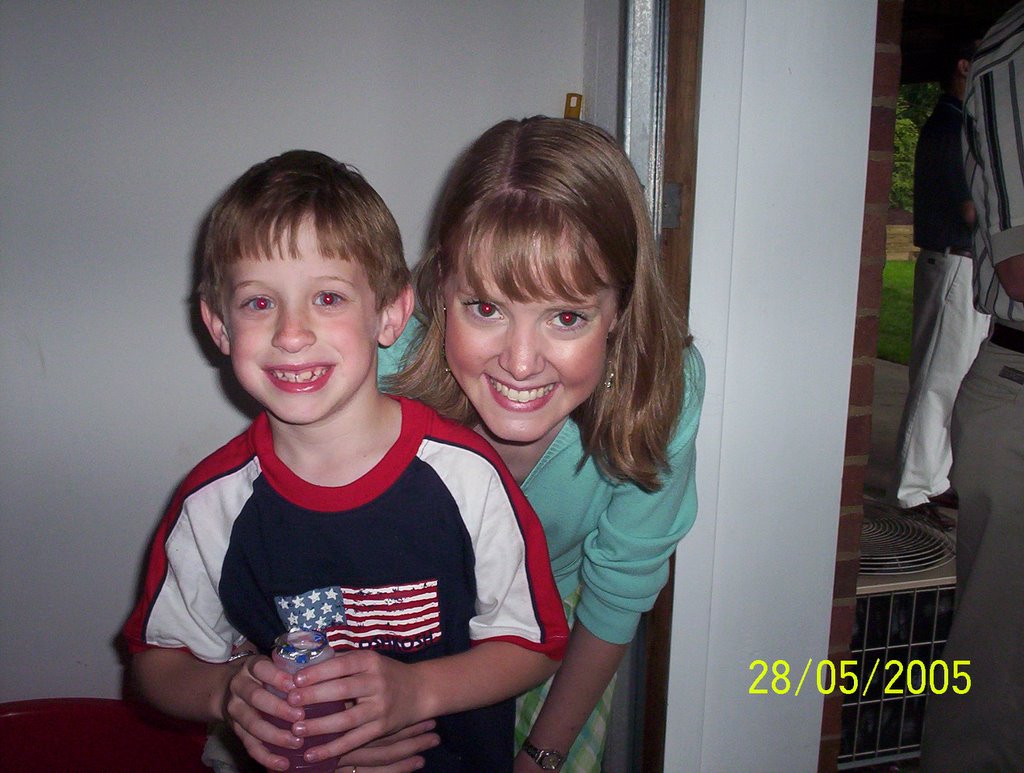

A Happy Immaculate Conception to you and yours (non-Catholics who read this site, just nod and read something else :) )--now get thee to a church!! It is a Holy Day of Obligation, after all. :)
And Happy Birthday to my godson, Ryan, who turns (gulp) eight today!! (Man I'm old...)
photos: Ryan and I at various events....I love this kid!!
Wednesday, December 07, 2005
On the bright side...
The critics in a recent Reuters (I know! gasp!) article have liked Narnia, so far, including ones in the U.K., where presumably they would be more critical, being the birthplace of Lewis and all. Some bits:
LOS ANGELES (Reuters) - It took C.S. Lewis five years to write "Chronicles of Narnia," one of the best-loved children's series of all time, and a half-century for his heirs to get it to the big screen but positive early reviews indicate the old fashioned yarn made the journey safely.
"The Chronicles of Narnia: The Lion, the Witch and the Wardrobe" opens on Friday in North America and widely in Europe in what the Walt Disney Co. and Walden Media hope will be the first of a series based on Lewis' seven books.
Los Angeles Times reviewer Carina Chocano described the film as "real by the logic of childhood" and noted that the book's much-discussed Christian themes do not overwhelm the simple tale of four children's adventures in Narnia.
"As a Christian primer, it's terrible. As a story, it's timeless," Chocano wrote in a review on Wednesday.
Television's Ebert & Roeper praised the cutting-edge special effects and called it "a fantasy that has charm ... beauty and enchantment."
Reviewers also praised the film for hewing faithfully to the novel's plot about four children who escape the World War II London Blitz to a country house owned by an old professor.
They discover a magical wardrobe that leads to a wintry world inhabited by talking animals, a white witch and a Christlike lion named Aslan.
***
Lewis once said that the idea for the Chronicles of Narnia began not with an intention to write Christian fables, but with the images of a faun carrying an umbrella, a queen on a sledge and a magnificent lion.
"At first there wasn't anything Christian about them. That element pushed itself in of its own accord," he wrote.
Christian viewers will see parallels between scenes in the film involving the death and rebirth of Aslan, in which the two girls spend a night weeping over his dead body before he returns to life and the New Testament's description of the resurrection of Jesus.
GO SEE THIS MOVIE!! Please...it'll make a lot of Hollywooders mad, and it will have box office execs. scratching their heads yet again....
LOS ANGELES (Reuters) - It took C.S. Lewis five years to write "Chronicles of Narnia," one of the best-loved children's series of all time, and a half-century for his heirs to get it to the big screen but positive early reviews indicate the old fashioned yarn made the journey safely.
"The Chronicles of Narnia: The Lion, the Witch and the Wardrobe" opens on Friday in North America and widely in Europe in what the Walt Disney Co. and Walden Media hope will be the first of a series based on Lewis' seven books.
Los Angeles Times reviewer Carina Chocano described the film as "real by the logic of childhood" and noted that the book's much-discussed Christian themes do not overwhelm the simple tale of four children's adventures in Narnia.
"As a Christian primer, it's terrible. As a story, it's timeless," Chocano wrote in a review on Wednesday.
Television's Ebert & Roeper praised the cutting-edge special effects and called it "a fantasy that has charm ... beauty and enchantment."
Reviewers also praised the film for hewing faithfully to the novel's plot about four children who escape the World War II London Blitz to a country house owned by an old professor.
They discover a magical wardrobe that leads to a wintry world inhabited by talking animals, a white witch and a Christlike lion named Aslan.
***
Lewis once said that the idea for the Chronicles of Narnia began not with an intention to write Christian fables, but with the images of a faun carrying an umbrella, a queen on a sledge and a magnificent lion.
"At first there wasn't anything Christian about them. That element pushed itself in of its own accord," he wrote.
Christian viewers will see parallels between scenes in the film involving the death and rebirth of Aslan, in which the two girls spend a night weeping over his dead body before he returns to life and the New Testament's description of the resurrection of Jesus.
GO SEE THIS MOVIE!! Please...it'll make a lot of Hollywooders mad, and it will have box office execs. scratching their heads yet again....
Anti-Narnia press begins...
Seems like there's a weird Anti-Narnia conspiracy going on out there...I noticed the Columbus Dispatch had an article Sunday subtley trashing the literary value of the books, which seems kind of dodgy to me, with one of the people interviewed saying that the only reason for their longevity is because people read them when then were kids, loved them, and didn't read them again. Obviously, I disagree, as do many other Lewis lovers I know.
The Corner is following this, as is Red State blog....more there....
Narnia Hate Watch
By: Paul J Cella · Section: Culture
Here at Redstate we have been struck by the level of unabashed odium that the upcoming film The Chronicles of Narnia has already provoked. Not since The Passion of the Christ have we seen such hatred for a film yet to be released. Thus we inaugurate the NARNIA HATE WATCH.
(102 comments, 529 words in story) Read Story & Discuss Dec 7th, 2005: 09:33:38
www.redstate.org, if you want to read it. I will try to follow and update you all.
Narnia fans unite--go see the movie in DROVES this weekend! I already have my ticket (thanks, Troy!!)
The Corner is following this, as is Red State blog....more there....
Narnia Hate Watch
By: Paul J Cella · Section: Culture
Here at Redstate we have been struck by the level of unabashed odium that the upcoming film The Chronicles of Narnia has already provoked. Not since The Passion of the Christ have we seen such hatred for a film yet to be released. Thus we inaugurate the NARNIA HATE WATCH.
(102 comments, 529 words in story) Read Story & Discuss Dec 7th, 2005: 09:33:38
www.redstate.org, if you want to read it. I will try to follow and update you all.
Narnia fans unite--go see the movie in DROVES this weekend! I already have my ticket (thanks, Troy!!)
No Christmas Day church for some evangelicals
I find it rather odd that megachurches around the country are closing their churches on Christmas day, ostenibly one of the holiest days on the Christian calendar (hat tip: Amy Welborn's blog, Open Book). Most of them are justifying it by saying that no one (or hardly no one) comes to church on Christmas day anyway, and for those who do, they're offering extra Christmas Eve services.
This seems really, really weird. I mean, first of all it's Sunday, which is the sabbath anyway, which means the churches would be open as a matter of course. It's not like Christmas is falling on a Wednesday or some "off-day" for churches and pastors. I've read the argument in several places that people just don't want to "go through lots of Christmas Eve services and then wake up six hours later to do Christmas day." Hmmm. And then there's the whole "we can worship God places other than a church" and "we want the pastor to have the time with his family like we have."
Lots of hmms for this Catholic here. First of all, we always have Masses both days, since Christmas is one of 9 Holy Days of Obligation where you have to attend, or else. :) My parish usually has 4 Christmas Eve (including Midnight Mass, which I as a member of the choir attend so I can sing), and two or three on Christmas Day, including the Mass at Dawn. Yes, Dawn. All of these are said by the parish priest. So a Catholic priest doesn't want to have time with his family? Um, I think he does. Yet he's a priest which means that service to his congregation comes first. I'm not saying that it doesn't for Protestants, but I find it odd that these members want their pastor to have the 'day off'. If he's a pastor, isn't his first priority serving God through his congregation? And doesn't that occassionally require sacrifice? I realize it's probably not as convenient for him as for a Catholic priest, who literally lives on the church grounds in the rectory and usually only has to walk a few feet to Mass, but still. It's Christmas and it's a Sunday . I think we could have the churches open, even if there's only 15 or so people there. Catholic parishes offer Mass daily, and at 7:00 or 8:00 AM I'm sure the churches are not packed. Yet the priest celebrates Mass for those present; to have a valid Mass, you only need the priest and one parishioner. That's it. And also the whole idea of you can worship God at home isn't foreign to Catholics, either. We pray at home--quite a bit, actually. But the Mass is different. The Mass is about community, and it's about, above all, receiving the Eucharist, which cannot be done at home (well, unless your bedridden or homebound in which case it can be brought to you. But that's a different story). But I guess this relates to the whole idea of Catholic vrs. Protestant worship ideas, which I won't get into here.
I just find this all very odd. If some of my non-Catholic readers could venture some reasonable explanations other than the ones listed below, I'd be very interested to read them.
This seems really, really weird. I mean, first of all it's Sunday, which is the sabbath anyway, which means the churches would be open as a matter of course. It's not like Christmas is falling on a Wednesday or some "off-day" for churches and pastors. I've read the argument in several places that people just don't want to "go through lots of Christmas Eve services and then wake up six hours later to do Christmas day." Hmmm. And then there's the whole "we can worship God places other than a church" and "we want the pastor to have the time with his family like we have."
Lots of hmms for this Catholic here. First of all, we always have Masses both days, since Christmas is one of 9 Holy Days of Obligation where you have to attend, or else. :) My parish usually has 4 Christmas Eve (including Midnight Mass, which I as a member of the choir attend so I can sing), and two or three on Christmas Day, including the Mass at Dawn. Yes, Dawn. All of these are said by the parish priest. So a Catholic priest doesn't want to have time with his family? Um, I think he does. Yet he's a priest which means that service to his congregation comes first. I'm not saying that it doesn't for Protestants, but I find it odd that these members want their pastor to have the 'day off'. If he's a pastor, isn't his first priority serving God through his congregation? And doesn't that occassionally require sacrifice? I realize it's probably not as convenient for him as for a Catholic priest, who literally lives on the church grounds in the rectory and usually only has to walk a few feet to Mass, but still. It's Christmas and it's a Sunday . I think we could have the churches open, even if there's only 15 or so people there. Catholic parishes offer Mass daily, and at 7:00 or 8:00 AM I'm sure the churches are not packed. Yet the priest celebrates Mass for those present; to have a valid Mass, you only need the priest and one parishioner. That's it. And also the whole idea of you can worship God at home isn't foreign to Catholics, either. We pray at home--quite a bit, actually. But the Mass is different. The Mass is about community, and it's about, above all, receiving the Eucharist, which cannot be done at home (well, unless your bedridden or homebound in which case it can be brought to you. But that's a different story). But I guess this relates to the whole idea of Catholic vrs. Protestant worship ideas, which I won't get into here.
I just find this all very odd. If some of my non-Catholic readers could venture some reasonable explanations other than the ones listed below, I'd be very interested to read them.
The White House "Holiday" Card
OK, I think some of the religious right have officially jumped the shark--they're going after G.W. as "giving in" to leftist, secularist pressure by saying "happy holidays" on the White House Christmas card.
This year was the first year I even got a White House Christmas Card, and I was pretty excited. It's cool--it's the White House in the snow with the First Pets in the yard, frolicing. I like it. The inside has an O.T. verse and says "happy holiday" yada yada yada and is "signed" (a la autopen, probably...sadly) by G.W. and the great Laura. I was thrilled just to get one. But some folks, including, unfortunately, William Donahue of the Catholic League ( A group I ususally agree with, obviously) has said that G.W. has abandoned Christianity and that this has gone too far.
Come on, people. Let's get real. Compared to most Presidents (including the sainted Jimmy Carter), G.W. has done more for the religious right than any president I can think of. He's given us faith-based initiatives, he's nominated religious men and women to the courts, he talks freely about his faith and God in public. He is clearly a Christian who holds his faith deeply and seriously. I don't have a problem with "happy holidays" when it's a massed-produced card (like the White House's is) going to millions of folks who may not celebrate Christmas. I'm sure Jews and Muslims and others are members of the RNC and get the card, too. Yes, I'm sure most Republicans are probably Christian. But still. Let's err on the side of caution here.
No, that doesn't mean that I want Christmas trees called "holiday trees"! Christmas trees are clearly a Christian, Christmas tradition. It would be like calling a menorah a holiday candlelabra, as I've noted before. But when it comes to the White House, I'm not really all that offended to get a card that says "happy holidays". That's fine. It has an O.T. verse, and even Jerry Falwell is OK with that. So let's all calm down and breathe. It's all good. G.W. is still a good religious conservative. Relax, folks, and focus on fighting the ACLU over manger scenes and Christmas songs in high schools. Those are fights we can win.
This year was the first year I even got a White House Christmas Card, and I was pretty excited. It's cool--it's the White House in the snow with the First Pets in the yard, frolicing. I like it. The inside has an O.T. verse and says "happy holiday" yada yada yada and is "signed" (a la autopen, probably...sadly) by G.W. and the great Laura. I was thrilled just to get one. But some folks, including, unfortunately, William Donahue of the Catholic League ( A group I ususally agree with, obviously) has said that G.W. has abandoned Christianity and that this has gone too far.
Come on, people. Let's get real. Compared to most Presidents (including the sainted Jimmy Carter), G.W. has done more for the religious right than any president I can think of. He's given us faith-based initiatives, he's nominated religious men and women to the courts, he talks freely about his faith and God in public. He is clearly a Christian who holds his faith deeply and seriously. I don't have a problem with "happy holidays" when it's a massed-produced card (like the White House's is) going to millions of folks who may not celebrate Christmas. I'm sure Jews and Muslims and others are members of the RNC and get the card, too. Yes, I'm sure most Republicans are probably Christian. But still. Let's err on the side of caution here.
No, that doesn't mean that I want Christmas trees called "holiday trees"! Christmas trees are clearly a Christian, Christmas tradition. It would be like calling a menorah a holiday candlelabra, as I've noted before. But when it comes to the White House, I'm not really all that offended to get a card that says "happy holidays". That's fine. It has an O.T. verse, and even Jerry Falwell is OK with that. So let's all calm down and breathe. It's all good. G.W. is still a good religious conservative. Relax, folks, and focus on fighting the ACLU over manger scenes and Christmas songs in high schools. Those are fights we can win.
Saddam trial: "This is terrorism"
OK, this isn't a religious post, but I was watching TV coverage of the Saddam trial today, where he refused to attend court and said that not receiving clean change of clothes was "terrorism". Um, excuse me, but somehow I doubt that your victims--who have so far described being raped and tortured by guards and seeing human hair in a shredder--would agree....
mini-series reminder
Hey, be sure to tune in to your local CBS affiliate to watch the second half of the JP the Great mini-series that starts at 8 (I believe--check local listings). If, like me, you're going to be in church for the vigil Mass of the Immaculate Conception, then TiVo or tape the show and catch the rest when you get home. The first part was good and it has Vatican approval! Let's try to get some good ratings for this and maybe we'll see more of this stuff (or not...this is network TV, after all).
carol
Today's entry:
O Ye heights of Heav'n adore him
Angel hosts His praises sing
Pow'rs, Dominions fall before Him
And extol our God and King
Let no tongue on Earth be silent
Eve'ry voice in concert ring
Ev'ermore and Ev'ermore!
Yesterday's carol: O Come, All Ye Faithful
O Ye heights of Heav'n adore him
Angel hosts His praises sing
Pow'rs, Dominions fall before Him
And extol our God and King
Let no tongue on Earth be silent
Eve'ry voice in concert ring
Ev'ermore and Ev'ermore!
Yesterday's carol: O Come, All Ye Faithful
Tuesday, December 06, 2005
"Jesus Did Not Die Just for Heterosexuals"
Sigh. More Vatican document response, this time from the gay Catholic Community in Miami. From the
Miami Herald via Yahoo! News (yes it's long...we're still working on the linking issue, folks...trust me, it'll happen).
My comments are sprinkled throughout--article text is in italics....
True to Catholic tradition, Joe Mele marched a crucifix to the altar ahead of the priest this past Sunday, rang the Sanctus bell at the right times and pressed a wine-filled chalice to the lips of the faithful during Communion, solemnly intoning the words ``the blood of Christ.''
But when asked what he thought about the Vatican, which is expected to issue an edict today barring most gay seminarians, Mele, 58, arched a bushy eyebrow and wryly asked, ``Who?''
Hard feelings toward the Vatican run strong among congregants at the weekly services held by Dignity USA, a national organization for gay and lesbian Catholics that is not recognized by the Archdiocese of Miami, nor, at a national level, by the Roman Catholic Church.
Mele is one of 40 or so members of the group's Fort Lauderdale chapter. Like them, he struggled with the Vatican's hard line against homosexuality, before reaching the heartfelt conclusion that he was entitled to practice his faith as a homosexual, regardless of what the church's highest earthly authority said.
''You have these old people, these cardinals, out of touch with the laity. The church is the people and the people are the church,'' said Richard Rogers, 68, who is heavily involved with Dignity Fort Lauderdale, and has been with the same male partner for 42 years.
''I was born a Catholic, and I will die a Catholic,'' he said. ``They're not going to chase me away from the Catholic Church.''
Um, Cardinals are not supposed to be "in touch" with the laity. They're supposed to be "in touch" with Catholic doctrine and what the Church says is right. This is not a political contest. Also, we're not trying to get gays out of the Catholic church--we're just trying to make sure the priesthood actually reflects a) the values and lifestyle appropriate for the priesthood and b) that priests who make it out of the seminaries are teaching what the Church actually believes, and not what they think/wish it believed.
BORROWED CHAPEL
For Dignity's Fort Lauderdale group at least, being both gay and faithfully Catholic means holding services in a borrowed chapel and hearing Mass from a rotating cast of sometimes underground priests.
Mary Ross Agosta, Archdiocese of Miami spokeswoman, said the archdiocese is affiliated with a ministry called Courage, a support network for people who have same-sex sexual attractions but want to live ``chaste Christian lives.''
''Any sexual activity outside the sacrament of marriage is considered a sin,'' Agosta said.
The Vatican's new directive hints that chaste, formerly gay men could still become priests, but it bars from seminaries those who ''practice homosexuality, present deeply rooted homosexual tendencies or support so-called gay culture.'' It also describes homosexual acts as ``grave sins.''
The edict was posted online by an Italian news agency last week, but the Vatican is expected to formally publish it today.
While observers note the Vatican is merely restating a 44-year-old stance barring gay men from the priesthood, the document is widely believed to be a response to the church's recent spate of sexual abuse scandals. Dignity members believe the directive reveals how the Vatican wrongly conflates homosexuality with pedophilia, using gays as scapegoats instead of closely examining the roots of the abuse.
''The Vatican's running scared right now, and when people are scared, they point fingers at what they don't understand,'' said Maribel Pardo, 43, a middle school teacher and Dignity member who once spent six years in a monastery. ``If you keep your vows of celibacy, it doesn't matter what your orientation is.''
Yes, Ms. Pardo, that's the point. If you keep your vows of celibacy. But that's not the problem here. A lot of them don't. And would someone make these people read Goodbye, Good Men ? It answers a lot of these ideas that there's not a problem with a gay culture in the seminaries that undermines Church teachings. And your orientation does matter if it's leading you to teach and preach things that are not in line with doctrine. Like I've said, I don't care what you are, as long as you're celibate. And I don't think this document is about that. I think it's about rooting out a problem that's been left unattended for a long time, especially in the American church.
Yet it was precisely because of their sexual orientation that Dignity members left the traditional Roman Catholic church 19 years ago, after publicly rejecting a letter issued by Cardinal Joseph Ratzinger, now Pope Benedict XVI, that described homosexual acts as ''intrinsically evil.'' Sam Sinnett, Dignity USA's national president, said the group's mission was to reclaim Catholicism while healing many of its followers' scars. Even though many gays have fled Catholicism, the group's national membership grew by 85 percent to more than 3,600 in the past two years, he said.
So you say above that you're not going to leave the Church, but you leave it because the Church says the way you're living is wrong. Hmmm. Sounds like "cafeteria Catholicism" to me. If you joined the Catholic church looking for a rubber stamp on lifestyle issues, you joined the wrong place. And if you were born into the Catholic faith and now live or think in ways that disagree with that faith and that Church, then clearly being Catholic is not for you. so perhaps instead of forming our own Catholicism, we should find a church that better suits the way we view God and the world, hm? Because what's best for the Church is to have multiple splinter groups.
`DEEPLY WOUNDED'
''There are people deeply wounded and hurt by the virulent language of the Vatican and other bishops,'' Sinnett said. ``Part of what we do is to help overcome the incredible damage that the institutional church has done.''
Dignity Fort Lauderdale's weekly services are held Sunday nights in a small chapel tucked behind the non-denominational Sunshine Cathedral in a quiet part of town. Crucifixes, statues of Jesus and the Virgin Mary adorn the altar, along with two pictures, one of the saints Sergio and Bacchus, the other of Saints Perpetua and Felicity, embracing. Masses are said by a rotating clergy of Franciscan and Independent Orthodox Christian priests, who embrace inclusion, and an occasional priest from the archdiocese, who must work with Dignity on the sly.
Gee, perhaps these members of the Clergy are what the Vatican is talking about when it talks about priests who embrace the "gay subculture" or support the gay lifestyle/ gay agenda. And this isn't a problem? The fact that these priests, who also have other parishes (at least that's what it sounds like), who are supposed to teach and preach what the Church believes (and not what they WISH the Church believes), yet don't, isn't an issue???
The services are Catholic to a fault, yet this past Sunday, before a congregation of 17, a notable deviation from the mainstream came from Bishop Michael Hillis, who led the Mass. After reading the Gospel, Hillis, a Franciscan with the Reconciliation Catholic Church, which caters to disenfranchised Catholics, quickly launched into an attack on the Vatican.
''Many things are happening with our seminarians, and it involves all of us,'' Hillis said forcefully. ``I wish some people could get it through their thick skulls that when Jesus Christ died on the cross, He did not die just for heterosexuals. He did not die just for homosexuals. He died for everyone.''
Well gee. I bet any first grader could tell you that. We (those "heterosexuals") know that Jesus didn't die just for us. He died for everyone. Lord knows no one's perfect. But the Vatican isn't saying that Jesus didn't die for gays. It's saying that perhaps active gays and men who support gay culture (like, apparently, this priest) perhaps should not be teaching doctrine with which they disagree or live to the contrary. Yet we have to be the "bad guys". And this is coming from a priest!!!!!
Later, a few congregants said they had tried out Judaism, Pentecostalism and the Baptist faith but found themselves strongly pulled back to Catholicism . Nearly all agreed they could only practice their religion by shutting out much of what the Vatican said.
'I hit bottom with my faith. I was angry that God made me the way I was, and asked `help me be straight,' '' said Mary Sullivan, 39, a Fort Lauderdale nurse. ``I had to heal that part of me that the church condemned. And I realized God made me this way, and God doesn't make junk.''
''When I walked through those doors,'' Sullivan added, ``I felt I had come home.''
OK, so you feel pulled to Catholicism , yet you don't agree with what it teaches and are going against the Vatican and Church doctrine. That's a pretty odd attraction. I can understand loving your faith--I love it everyday--but I also know that the Church teaches submission in trials. It doesn't say, "well we know you like Catholicism so we'll tweak it for you." God does not "make junk", as this woman says, but he also doesn't like it when we violate what He's asked us to do. For years, Catholics have preached "love the sinner, hate the sin." We don't dislike gays, we don't think they're going to hell, etc., etc. What I don't like is this whole idea that just because the Vatican doesn't think that it's all righty for an active gay man to be a priest, then the Church is "shutting them out". Catholic moms would tell you to "offer it up." I know that can sound trite and cold, but it's the best thing to do.
A personal example: even after my transplant (OK, probably especially after my transplant), I'm not advised to have children. My docs have made it pretty clear that, at least for me, having my own kids is out. This, as you might imagine, is a huge letdown for me, because I love kids and have always wanted a whole horde. When I was engaged, at first I thought we might use birth control; I talked to a few priests about it, and they said it would probably be OK, given my condition, and that we weren't doing it in a selfish way.
But the more I thought about it, the more I knew that that wasn't right. I wanted to follow God's law to the letter, so I read the catechism, which is pretty explicit--there are no exceptions listed for birth control use. So, after prayer, I decided that we weren't going to use it, and use NPF like I was taught to do. My fiance wasn't Catholic, so this was difficult to discuss with him, though I tried.
My fiance was understandably thrown for a loop, and this began our road to break up, I think. I told him at one point that I loved him, but I loved God more (yes, I really said that...I'm not trying to make myself sound better than I am). It was tough. Very tough. It made me quite unhappy. It has left me open to the possibility that I might not ever get married because of the way I feel about this. That's hard. This is another challenge for me. But it doesn't make me want to leave the Church, and it certainly doesn't want to make me ignore the Vatican and what the Church teaches. I have to pray about it and hope that God gives me the strength and consolation I need to be faithful. It can be hard. Very hard. I struggle with it often. But I know that being faithful will pay off, because, in the end, God is all we've got.
I wish that the members of the gay community who are so angry about this instruction could try to see what the Church is doing and pray about it. I'm sure many of them have prayed about it, in various forms. Surrender to God's will is hard. But the rewards are worth it--at least, I think so.
Miami Herald via Yahoo! News (yes it's long...we're still working on the linking issue, folks...trust me, it'll happen).
My comments are sprinkled throughout--article text is in italics....
True to Catholic tradition, Joe Mele marched a crucifix to the altar ahead of the priest this past Sunday, rang the Sanctus bell at the right times and pressed a wine-filled chalice to the lips of the faithful during Communion, solemnly intoning the words ``the blood of Christ.''
But when asked what he thought about the Vatican, which is expected to issue an edict today barring most gay seminarians, Mele, 58, arched a bushy eyebrow and wryly asked, ``Who?''
Hard feelings toward the Vatican run strong among congregants at the weekly services held by Dignity USA, a national organization for gay and lesbian Catholics that is not recognized by the Archdiocese of Miami, nor, at a national level, by the Roman Catholic Church.
Mele is one of 40 or so members of the group's Fort Lauderdale chapter. Like them, he struggled with the Vatican's hard line against homosexuality, before reaching the heartfelt conclusion that he was entitled to practice his faith as a homosexual, regardless of what the church's highest earthly authority said.
''You have these old people, these cardinals, out of touch with the laity. The church is the people and the people are the church,'' said Richard Rogers, 68, who is heavily involved with Dignity Fort Lauderdale, and has been with the same male partner for 42 years.
''I was born a Catholic, and I will die a Catholic,'' he said. ``They're not going to chase me away from the Catholic Church.''
Um, Cardinals are not supposed to be "in touch" with the laity. They're supposed to be "in touch" with Catholic doctrine and what the Church says is right. This is not a political contest. Also, we're not trying to get gays out of the Catholic church--we're just trying to make sure the priesthood actually reflects a) the values and lifestyle appropriate for the priesthood and b) that priests who make it out of the seminaries are teaching what the Church actually believes, and not what they think/wish it believed.
BORROWED CHAPEL
For Dignity's Fort Lauderdale group at least, being both gay and faithfully Catholic means holding services in a borrowed chapel and hearing Mass from a rotating cast of sometimes underground priests.
Mary Ross Agosta, Archdiocese of Miami spokeswoman, said the archdiocese is affiliated with a ministry called Courage, a support network for people who have same-sex sexual attractions but want to live ``chaste Christian lives.''
''Any sexual activity outside the sacrament of marriage is considered a sin,'' Agosta said.
The Vatican's new directive hints that chaste, formerly gay men could still become priests, but it bars from seminaries those who ''practice homosexuality, present deeply rooted homosexual tendencies or support so-called gay culture.'' It also describes homosexual acts as ``grave sins.''
The edict was posted online by an Italian news agency last week, but the Vatican is expected to formally publish it today.
While observers note the Vatican is merely restating a 44-year-old stance barring gay men from the priesthood, the document is widely believed to be a response to the church's recent spate of sexual abuse scandals. Dignity members believe the directive reveals how the Vatican wrongly conflates homosexuality with pedophilia, using gays as scapegoats instead of closely examining the roots of the abuse.
''The Vatican's running scared right now, and when people are scared, they point fingers at what they don't understand,'' said Maribel Pardo, 43, a middle school teacher and Dignity member who once spent six years in a monastery. ``If you keep your vows of celibacy, it doesn't matter what your orientation is.''
Yes, Ms. Pardo, that's the point. If you keep your vows of celibacy. But that's not the problem here. A lot of them don't. And would someone make these people read Goodbye, Good Men ? It answers a lot of these ideas that there's not a problem with a gay culture in the seminaries that undermines Church teachings. And your orientation does matter if it's leading you to teach and preach things that are not in line with doctrine. Like I've said, I don't care what you are, as long as you're celibate. And I don't think this document is about that. I think it's about rooting out a problem that's been left unattended for a long time, especially in the American church.
Yet it was precisely because of their sexual orientation that Dignity members left the traditional Roman Catholic church 19 years ago, after publicly rejecting a letter issued by Cardinal Joseph Ratzinger, now Pope Benedict XVI, that described homosexual acts as ''intrinsically evil.'' Sam Sinnett, Dignity USA's national president, said the group's mission was to reclaim Catholicism while healing many of its followers' scars. Even though many gays have fled Catholicism, the group's national membership grew by 85 percent to more than 3,600 in the past two years, he said.
So you say above that you're not going to leave the Church, but you leave it because the Church says the way you're living is wrong. Hmmm. Sounds like "cafeteria Catholicism" to me. If you joined the Catholic church looking for a rubber stamp on lifestyle issues, you joined the wrong place. And if you were born into the Catholic faith and now live or think in ways that disagree with that faith and that Church, then clearly being Catholic is not for you. so perhaps instead of forming our own Catholicism, we should find a church that better suits the way we view God and the world, hm? Because what's best for the Church is to have multiple splinter groups.
`DEEPLY WOUNDED'
''There are people deeply wounded and hurt by the virulent language of the Vatican and other bishops,'' Sinnett said. ``Part of what we do is to help overcome the incredible damage that the institutional church has done.''
Dignity Fort Lauderdale's weekly services are held Sunday nights in a small chapel tucked behind the non-denominational Sunshine Cathedral in a quiet part of town. Crucifixes, statues of Jesus and the Virgin Mary adorn the altar, along with two pictures, one of the saints Sergio and Bacchus, the other of Saints Perpetua and Felicity, embracing. Masses are said by a rotating clergy of Franciscan and Independent Orthodox Christian priests, who embrace inclusion, and an occasional priest from the archdiocese, who must work with Dignity on the sly.
Gee, perhaps these members of the Clergy are what the Vatican is talking about when it talks about priests who embrace the "gay subculture" or support the gay lifestyle/ gay agenda. And this isn't a problem? The fact that these priests, who also have other parishes (at least that's what it sounds like), who are supposed to teach and preach what the Church believes (and not what they WISH the Church believes), yet don't, isn't an issue???
The services are Catholic to a fault, yet this past Sunday, before a congregation of 17, a notable deviation from the mainstream came from Bishop Michael Hillis, who led the Mass. After reading the Gospel, Hillis, a Franciscan with the Reconciliation Catholic Church, which caters to disenfranchised Catholics, quickly launched into an attack on the Vatican.
''Many things are happening with our seminarians, and it involves all of us,'' Hillis said forcefully. ``I wish some people could get it through their thick skulls that when Jesus Christ died on the cross, He did not die just for heterosexuals. He did not die just for homosexuals. He died for everyone.''
Well gee. I bet any first grader could tell you that. We (those "heterosexuals") know that Jesus didn't die just for us. He died for everyone. Lord knows no one's perfect. But the Vatican isn't saying that Jesus didn't die for gays. It's saying that perhaps active gays and men who support gay culture (like, apparently, this priest) perhaps should not be teaching doctrine with which they disagree or live to the contrary. Yet we have to be the "bad guys". And this is coming from a priest!!!!!
Later, a few congregants said they had tried out Judaism, Pentecostalism and the Baptist faith but found themselves strongly pulled back to Catholicism . Nearly all agreed they could only practice their religion by shutting out much of what the Vatican said.
'I hit bottom with my faith. I was angry that God made me the way I was, and asked `help me be straight,' '' said Mary Sullivan, 39, a Fort Lauderdale nurse. ``I had to heal that part of me that the church condemned. And I realized God made me this way, and God doesn't make junk.''
''When I walked through those doors,'' Sullivan added, ``I felt I had come home.''
OK, so you feel pulled to Catholicism , yet you don't agree with what it teaches and are going against the Vatican and Church doctrine. That's a pretty odd attraction. I can understand loving your faith--I love it everyday--but I also know that the Church teaches submission in trials. It doesn't say, "well we know you like Catholicism so we'll tweak it for you." God does not "make junk", as this woman says, but he also doesn't like it when we violate what He's asked us to do. For years, Catholics have preached "love the sinner, hate the sin." We don't dislike gays, we don't think they're going to hell, etc., etc. What I don't like is this whole idea that just because the Vatican doesn't think that it's all righty for an active gay man to be a priest, then the Church is "shutting them out". Catholic moms would tell you to "offer it up." I know that can sound trite and cold, but it's the best thing to do.
A personal example: even after my transplant (OK, probably especially after my transplant), I'm not advised to have children. My docs have made it pretty clear that, at least for me, having my own kids is out. This, as you might imagine, is a huge letdown for me, because I love kids and have always wanted a whole horde. When I was engaged, at first I thought we might use birth control; I talked to a few priests about it, and they said it would probably be OK, given my condition, and that we weren't doing it in a selfish way.
But the more I thought about it, the more I knew that that wasn't right. I wanted to follow God's law to the letter, so I read the catechism, which is pretty explicit--there are no exceptions listed for birth control use. So, after prayer, I decided that we weren't going to use it, and use NPF like I was taught to do. My fiance wasn't Catholic, so this was difficult to discuss with him, though I tried.
My fiance was understandably thrown for a loop, and this began our road to break up, I think. I told him at one point that I loved him, but I loved God more (yes, I really said that...I'm not trying to make myself sound better than I am). It was tough. Very tough. It made me quite unhappy. It has left me open to the possibility that I might not ever get married because of the way I feel about this. That's hard. This is another challenge for me. But it doesn't make me want to leave the Church, and it certainly doesn't want to make me ignore the Vatican and what the Church teaches. I have to pray about it and hope that God gives me the strength and consolation I need to be faithful. It can be hard. Very hard. I struggle with it often. But I know that being faithful will pay off, because, in the end, God is all we've got.
I wish that the members of the gay community who are so angry about this instruction could try to see what the Church is doing and pray about it. I'm sure many of them have prayed about it, in various forms. Surrender to God's will is hard. But the rewards are worth it--at least, I think so.
mini-series UPDATE
OK, so I lied...the mini-series conclusion on CBS is TOMORROW evening at 8:00. I know that a lot of you may be in a Vigil Mass for the Immaculate Conception (as I will be), so be sure to TiVo it (or tape it, if you have an ancient system like our house does). But don't try to catch it tonight--you'll be 24 hours too early!!
Esoteric sign
Sign seen in a protestant churchyard in downtown Columbus:
"Saturday 5:00 Informal/ Communion"
Someone want to explain to me what, exactly, is informal about receiving Communion? (Sometimes the sign says Holy Eucharist)
I guess if you don't see it as Catholics do (that is, the actual presence of God in the Bread and Wine, which become and Body and Blood...spare me the transfiguration is a crock emails, please!), then it could be 'informal'. And we all have seen plenty of Catholics who dress as nicely for Mass as they do for an afternoon at the 'Shoe in Columbus. But at least we never go out of our way to note that informality is acceptable!
If anyone could explain to me how Communion/ Eucharist could be "informal" in any way, please let me know.
"Saturday 5:00 Informal/ Communion"
Someone want to explain to me what, exactly, is informal about receiving Communion? (Sometimes the sign says Holy Eucharist)
I guess if you don't see it as Catholics do (that is, the actual presence of God in the Bread and Wine, which become and Body and Blood...spare me the transfiguration is a crock emails, please!), then it could be 'informal'. And we all have seen plenty of Catholics who dress as nicely for Mass as they do for an afternoon at the 'Shoe in Columbus. But at least we never go out of our way to note that informality is acceptable!
If anyone could explain to me how Communion/ Eucharist could be "informal" in any way, please let me know.
An Anti-Sainthood campaign
This is news to me.
Welcome to the modern era--where you can potentially boycott a cause for sainthood?!
From Yahoo! News (OK, it's long, but bear with me):
VATICAN CITY (Reuters) - Dissident theologians opposed to the beatification of Pope John Paul have issued an appeal urging Catholics critical of the late pope to tell the Vatican if they also think he should not be made a saint. The 11 Catholic theologians said Church officials who are reviewing John Paul's life and pontificate should also consider the "negative evaluation" liberal critics have of the nearly 27-year-old papacy that ended when John Paul died in April.
The Rome diocese has opened a beatification cause for the Pope. Church officials have asked all Catholics to come forward with personal experiences or evidence of possible miracles that could support a reputation for holiness.
In their appeal, which received wide play in major Italian newspapers on Tuesday, the theologians from Italy, Spain, Austria and Latin America said those judging the case should also take into account "negative" aspects of John Paul's papacy.
One of the best-known signatories was Jose Maria Castillo, a Jesuit professor who has taught theology at the University of Granada. Another was Italian theologian Giovanni Franzoni.
"We invite such persons (critical of the late pope) to overcome their shyness and timidity and formally express, with gospel freedom, facts which according to their consciences and convictions should be an obstacle to beatification," they wrote.
CHURCH SCANDALS
While the theologians acknowledged John Paul's papacy had "positive aspects," their seven-point appeal included criticism of his rigidly conservative stand on issues such as contraception, limitations on the role of women, and of scandals in the Church. (emphasis mine)
It included the sexual abuse scandal that swept the United States in 2002, when it was discovered that priests who had molested children were moved from parish to parish instead of being defrocked or turned over to authorities.
The appeal criticized what it called a lack of control over some of the Vatican's "murky financial maneuvers," specifically naming the Holy See's relations with Italy's Banco Ambrosiano, which went bankrupt in 1982.
Italian magistrates at the time said the Vatican Bank, which had a small stake in the Ambrosiano, bore some responsibility for the $1.3 billion in bad debts. The Vatican denied wrongdoing but paid $250 million to creditors in what it called a goodwill gesture.
The theologians said the Church's saint makers should also consider the "repression and alienation" inflicted on some theologians by John Paul, a reference to his moves to discipline promoters of Latin America's "Liberation Theology," which he felt was too close to Marxist social analysis as a way of helping the continent's poor.
Last May, Pope Benedict put his predecessor on the fast track to possible sainthood by dispensing with Church rules that impose a five-year waiting period after a candidate's death before the procedure that leads to sainthood can even start.
One miracle is required after John Paul's death for the cause to move on to beatification, the last step before sainthood. The miracle must be the result of prayers asking the dead pope to intercede with God.
Another miracle would be necessary between beatification and eventual sainthood. Miracles are usually a physical healing which doctors are at a loss to explain.
OK, let's acknowledge that this was written by Reuters, which is probably the most left-leaning of the major wires. But let's look at the points here:
1. Geez, let's not make JP The Great a saint because he actually embodied Catholic doctrine and theology! Ooooh, this makes me mad. Liberals are going to try to have their way with him even after he's gone. GRRRRRRR. But believe you me that if he had been a liberal, he would've been canonized as soon as possible.
2. Um, so there were some banking issues? And this is the pope's problem how? And it is a barrier to sainthood how ????
3. Liberation theology's problems weren't just based on the pope's "feelings". They were based on fact. They made Jesus into a liberator crusader that has no bearing on his gospel teachings. In some document on Liberation Theology, someone cool (It may even have been B XVI in his official document on the topic when he was head of the Congregation) said that Liberation Theology never quite comes back to the nub of "Christ has died, Christ has risen, Christ will come again." The whole thing is about liberating you from oppression. While that's nice, that's not exactly the crux of Christianity. And it was Marxists/ Socialist in nature, which the Church is not. Study it, please.
All in all, I find this repulsive and gag-inducing. Instead of people who are against JP the Great sending emails, those of us who support his canonization should email, sending "facts which according to our consciences and reason" are for his canonization. But then again, the Left commonly supposes that the Catholic Conservatives don't have reason. We're just poor, dumb folks who blindly follow the Church's teachings and have babies in the woods, or something like that. We're too dumb to think. I'd really like to prove them wrong...
Welcome to the modern era--where you can potentially boycott a cause for sainthood?!
From Yahoo! News (OK, it's long, but bear with me):
VATICAN CITY (Reuters) - Dissident theologians opposed to the beatification of Pope John Paul have issued an appeal urging Catholics critical of the late pope to tell the Vatican if they also think he should not be made a saint. The 11 Catholic theologians said Church officials who are reviewing John Paul's life and pontificate should also consider the "negative evaluation" liberal critics have of the nearly 27-year-old papacy that ended when John Paul died in April.
The Rome diocese has opened a beatification cause for the Pope. Church officials have asked all Catholics to come forward with personal experiences or evidence of possible miracles that could support a reputation for holiness.
In their appeal, which received wide play in major Italian newspapers on Tuesday, the theologians from Italy, Spain, Austria and Latin America said those judging the case should also take into account "negative" aspects of John Paul's papacy.
One of the best-known signatories was Jose Maria Castillo, a Jesuit professor who has taught theology at the University of Granada. Another was Italian theologian Giovanni Franzoni.
"We invite such persons (critical of the late pope) to overcome their shyness and timidity and formally express, with gospel freedom, facts which according to their consciences and convictions should be an obstacle to beatification," they wrote.
CHURCH SCANDALS
While the theologians acknowledged John Paul's papacy had "positive aspects," their seven-point appeal included criticism of his rigidly conservative stand on issues such as contraception, limitations on the role of women, and of scandals in the Church. (emphasis mine)
It included the sexual abuse scandal that swept the United States in 2002, when it was discovered that priests who had molested children were moved from parish to parish instead of being defrocked or turned over to authorities.
The appeal criticized what it called a lack of control over some of the Vatican's "murky financial maneuvers," specifically naming the Holy See's relations with Italy's Banco Ambrosiano, which went bankrupt in 1982.
Italian magistrates at the time said the Vatican Bank, which had a small stake in the Ambrosiano, bore some responsibility for the $1.3 billion in bad debts. The Vatican denied wrongdoing but paid $250 million to creditors in what it called a goodwill gesture.
The theologians said the Church's saint makers should also consider the "repression and alienation" inflicted on some theologians by John Paul, a reference to his moves to discipline promoters of Latin America's "Liberation Theology," which he felt was too close to Marxist social analysis as a way of helping the continent's poor.
Last May, Pope Benedict put his predecessor on the fast track to possible sainthood by dispensing with Church rules that impose a five-year waiting period after a candidate's death before the procedure that leads to sainthood can even start.
One miracle is required after John Paul's death for the cause to move on to beatification, the last step before sainthood. The miracle must be the result of prayers asking the dead pope to intercede with God.
Another miracle would be necessary between beatification and eventual sainthood. Miracles are usually a physical healing which doctors are at a loss to explain.
OK, let's acknowledge that this was written by Reuters, which is probably the most left-leaning of the major wires. But let's look at the points here:
1. Geez, let's not make JP The Great a saint because he actually embodied Catholic doctrine and theology! Ooooh, this makes me mad. Liberals are going to try to have their way with him even after he's gone. GRRRRRRR. But believe you me that if he had been a liberal, he would've been canonized as soon as possible.
2. Um, so there were some banking issues? And this is the pope's problem how? And it is a barrier to sainthood how ????
3. Liberation theology's problems weren't just based on the pope's "feelings". They were based on fact. They made Jesus into a liberator crusader that has no bearing on his gospel teachings. In some document on Liberation Theology, someone cool (It may even have been B XVI in his official document on the topic when he was head of the Congregation) said that Liberation Theology never quite comes back to the nub of "Christ has died, Christ has risen, Christ will come again." The whole thing is about liberating you from oppression. While that's nice, that's not exactly the crux of Christianity. And it was Marxists/ Socialist in nature, which the Church is not. Study it, please.
All in all, I find this repulsive and gag-inducing. Instead of people who are against JP the Great sending emails, those of us who support his canonization should email, sending "facts which according to our consciences and reason" are for his canonization. But then again, the Left commonly supposes that the Catholic Conservatives don't have reason. We're just poor, dumb folks who blindly follow the Church's teachings and have babies in the woods, or something like that. We're too dumb to think. I'd really like to prove them wrong...
Perks of Being Pope....
From Ferrari on Monday...
His Holiness Pope Benedict XVI received a special gift from Ferrari on Monday - a steering wheel from one of Michael Schumacher’s title-winning F2004 cars, bearing the dedication: "The Formula 1 World Champion's steering wheel to His Holiness Benedict XVI, Christianity's driver."
A delegation from Ferrari, including President Luca di Montezemolo and Vice President Piero Ferrari were attending a special audience with the Pope to present him with a cheque for 950,000 Euro, raised from the sale of the company’s 400th Enzo road car, built especially to be auctioned for charity.
The proceeds of the car were promised by Ferrari for humanitarian purposes to the late Pope John Paul II in a previous papal audience attended by Schumacher and then team mate Rubens Barrichello back in January.
How cool is that? I mean, even though it'll probably end up being auctioned off for charity, or something...it's still pretty cool. I wonder if G.W. wants one, too, but I guess it's only natural that the Pope gets "better" gifts, while the President gets stuff like a "fifty-pound halibut" (if you can guess the reference, you must have been a poli sci major in college!).
His Holiness Pope Benedict XVI received a special gift from Ferrari on Monday - a steering wheel from one of Michael Schumacher’s title-winning F2004 cars, bearing the dedication: "The Formula 1 World Champion's steering wheel to His Holiness Benedict XVI, Christianity's driver."
A delegation from Ferrari, including President Luca di Montezemolo and Vice President Piero Ferrari were attending a special audience with the Pope to present him with a cheque for 950,000 Euro, raised from the sale of the company’s 400th Enzo road car, built especially to be auctioned for charity.
The proceeds of the car were promised by Ferrari for humanitarian purposes to the late Pope John Paul II in a previous papal audience attended by Schumacher and then team mate Rubens Barrichello back in January.
How cool is that? I mean, even though it'll probably end up being auctioned off for charity, or something...it's still pretty cool. I wonder if G.W. wants one, too, but I guess it's only natural that the Pope gets "better" gifts, while the President gets stuff like a "fifty-pound halibut" (if you can guess the reference, you must have been a poli sci major in college!).
TV: JP II mini-series to air tonight
Tonight will bring CBS' second part of their miniseries Pope John Paul II . If you missed it the first time around, scroll down to read my take on it, and be sure to tune in tonight. I'd like to see it get better rating than the first half (which could have been due to football running late...although JP II was a sportsman, I don't know if he'd be thrilled knowing he got bumped for pigskin...kidding! Just kidding!). The first half was quite good at showing the humanity of the pope as well as proclaiming what he believed quite fearlessly. I know that a "Charlie Brown Christmas" is also on, but switch over to CBS and watch Charlie later, or buy him on DVD. Let's try to boost the ratings here! (It has a BXVI thumbs up and Vatican approval...so you know it's kosher!)
NYC with a dubious title....
...that of the "abortion capital" of the United States. From The Corner: (http://corner.nationalreview.com...one of these days I'll get the link function on this site up and running....)
New York Magazine this week:
In 1970, New York passed the most permissive abortion law in America, one that defined the state as the country’s abortion refuge. Overnight, a new industry materialized in New York City, promoting itself to women across the country. The pitches were often blunt. A newspaper ad from the time inquired, “Want to be un-pregnant?”
Thirty-five years later, New York has the highest abortion rate in America. In 2000, the last year for which good data are available, 39 out of every 1,000 women in the state ended a pregnancy, for a total of 164,000 abortions that year. In America, one of every ten abortions occurs in New York, and in New York, seven of every ten abortions are performed in New York City. In absolute terms, there are more abortions performed on minors, more repeat abortions, and more late abortions (over 21 weeks) in New York City than anywhere else in the country. In parts of the city, the ratio of abortions to births is one to one. (emphasis mine)
Sigh. You know, a real Republican mayor would attempt to clean this up....but then he'd never get elected. We're in a catch-22, aren't we, with NYC elected officials....
Shouldn't the archbishop of NYC have some sort of comment about this?
New York Magazine this week:
In 1970, New York passed the most permissive abortion law in America, one that defined the state as the country’s abortion refuge. Overnight, a new industry materialized in New York City, promoting itself to women across the country. The pitches were often blunt. A newspaper ad from the time inquired, “Want to be un-pregnant?”
Thirty-five years later, New York has the highest abortion rate in America. In 2000, the last year for which good data are available, 39 out of every 1,000 women in the state ended a pregnancy, for a total of 164,000 abortions that year. In America, one of every ten abortions occurs in New York, and in New York, seven of every ten abortions are performed in New York City. In absolute terms, there are more abortions performed on minors, more repeat abortions, and more late abortions (over 21 weeks) in New York City than anywhere else in the country. In parts of the city, the ratio of abortions to births is one to one. (emphasis mine)
Sigh. You know, a real Republican mayor would attempt to clean this up....but then he'd never get elected. We're in a catch-22, aren't we, with NYC elected officials....
Shouldn't the archbishop of NYC have some sort of comment about this?
Carol
Today's entry:
God of God
Light of Light
Lo! He comes forth from the Virgin's Womb
Our very God
Begotten, not created
O Come let us adore Him
O come let us adore Him
O come let us adore Him
Christ the Lord
Yesterday's answer: "O Holy Night"
God of God
Light of Light
Lo! He comes forth from the Virgin's Womb
Our very God
Begotten, not created
O Come let us adore Him
O come let us adore Him
O come let us adore Him
Christ the Lord
Yesterday's answer: "O Holy Night"
Monday, December 05, 2005
Bookshelf: Remembering John Paul The Great
Peggy Noonan, of whom I am a great fan (she's sort of my icon when it comes to writing), has come out with a sublime and lovely new book: John Paul The Great: Remembering a Spiritual Father . Go to your nearest bookstore and pick up multiple copies of this great volume to give as Christmas presents, and don't forget one for yourself. This little book is chock-full of insights, recollections, and thoughts on the life and work of our late Holy Father and the impact he had on one person's life. But as you read it, I'm sure you'll find parallels to your own spiritual journey, and this book may help guide you on the path towards deepening that faith.
The book covers all sorts of topics, from the Rosary to prayer to the sex abuse scandal in the American church. Noonan discusses the Pope's past, the mysticism that shaped his papacy, the ideas of belief, and what his papacy and death mean to us. There is also the discussion of saints, the "dark night of the soul", his devotion to Mary, and all sorts of other things, including his part in the downfall of Communism and that first, great trip to Poland that marked the beginning of the end for the Communist regime. (Perhaps that's why the pope never got to Russia...barring Patriarch Alesky's opposition, of course...)
The book is profoundyet accessible, written in Noonan's trademark engaging style; the whole work feels like a conversation she's having with you personally. Some of the pieces are taken from her Opinion Journal articles, posted on http://www.opinionjournal.com, and expanded upon (i.e., her piece on the rosary, her piece on the first trip to Poland), which is nice for fans of her column (of which I am one). She writes with obvious love for her subject, which makes it that much more fun to read, because it's not one of the books where the author says, "yes, he was good, but let's not forget the bad parts" and then brings the whole thing down. Noonan mentions some of the "bad" parts of the papacy, but most of the book is just a great ode to a great man, whom she (and many others) saw as her "spiritiual father". Read this book and be inspired to deepen your prayer life and enjoy the legacy of this great man, told by a master wordsmith.
The book covers all sorts of topics, from the Rosary to prayer to the sex abuse scandal in the American church. Noonan discusses the Pope's past, the mysticism that shaped his papacy, the ideas of belief, and what his papacy and death mean to us. There is also the discussion of saints, the "dark night of the soul", his devotion to Mary, and all sorts of other things, including his part in the downfall of Communism and that first, great trip to Poland that marked the beginning of the end for the Communist regime. (Perhaps that's why the pope never got to Russia...barring Patriarch Alesky's opposition, of course...)
The book is profoundyet accessible, written in Noonan's trademark engaging style; the whole work feels like a conversation she's having with you personally. Some of the pieces are taken from her Opinion Journal articles, posted on http://www.opinionjournal.com, and expanded upon (i.e., her piece on the rosary, her piece on the first trip to Poland), which is nice for fans of her column (of which I am one). She writes with obvious love for her subject, which makes it that much more fun to read, because it's not one of the books where the author says, "yes, he was good, but let's not forget the bad parts" and then brings the whole thing down. Noonan mentions some of the "bad" parts of the papacy, but most of the book is just a great ode to a great man, whom she (and many others) saw as her "spiritiual father". Read this book and be inspired to deepen your prayer life and enjoy the legacy of this great man, told by a master wordsmith.
John Paul on CBS
I watched most of the John Paul II mini-series (part one) on CBS last night, and, for the most part, I found it quite good and entertainung, well-worth the time to watch and possibly (depending on the last installment, which will air Wednesday) worth buying when the inevitable DVD release comes out (well, at least I hope it's inevitable). The film, shot in Poland and with the approval and cooperation of the Vatican (leading some critics--and ABC's actor who played the pope--to deride the mini-series as Vatican "rubber stamped" and therefore losing edginess and such. Uh huh....), the film covers the pope's early life through his death (I think) this past April. The first section (at least what I saw) had him being ordained Auxiliary Bishop to Krakow and I'm pretty sure that the installment ended with his election, but I could be wrong.
The thing I most appreciated was seeing Catholicism, and especially John Paul II's Catholicism, portrayed in a positive light. There's a scene with Father Karol taking some students on a camping trip, and as they're loading the canoes for a river ride, JP II is instructing them in what would become his "theology of the body"--that is, how the Church views sex and relationships. And it's done in a way that shows how much JP II valued the human body and human sexuality as gifts from the Father to be used properly, to give Him glory, and to show love and respect for another human being. It's lovely. It also shows his close relationship with the Jews of Krakow, including a friend named Roman (he brings him food to eat when his friend has gone into hiding to avoid capture by the Nazis); his acting days with a theater company of friends; and the anguish he feels when his father dies, leaving him alone and unable to pray. It also shows the bravery of the Polish Church hierachy and the young men who were ordained with Karol after attending underground seminary in the evenings, something for which they surely would've been deported or worse for if the Nazis had discovered them. By watching movies about the Pope and reading about his life (in such books as Witness to Hope , George Weigel's outstanding biography of JP II, it is clear that this great man who told us "Be not afraid!" knew what he was talking about.
I'm looking forward to the second installment on Wednesday--leave your comments if you saw the film and let me know what you thought! If you missed the first installment, you can probably pick it up on Wednesday, anyway--it's not like you won't be able to follow it. :)
The thing I most appreciated was seeing Catholicism, and especially John Paul II's Catholicism, portrayed in a positive light. There's a scene with Father Karol taking some students on a camping trip, and as they're loading the canoes for a river ride, JP II is instructing them in what would become his "theology of the body"--that is, how the Church views sex and relationships. And it's done in a way that shows how much JP II valued the human body and human sexuality as gifts from the Father to be used properly, to give Him glory, and to show love and respect for another human being. It's lovely. It also shows his close relationship with the Jews of Krakow, including a friend named Roman (he brings him food to eat when his friend has gone into hiding to avoid capture by the Nazis); his acting days with a theater company of friends; and the anguish he feels when his father dies, leaving him alone and unable to pray. It also shows the bravery of the Polish Church hierachy and the young men who were ordained with Karol after attending underground seminary in the evenings, something for which they surely would've been deported or worse for if the Nazis had discovered them. By watching movies about the Pope and reading about his life (in such books as Witness to Hope , George Weigel's outstanding biography of JP II, it is clear that this great man who told us "Be not afraid!" knew what he was talking about.
I'm looking forward to the second installment on Wednesday--leave your comments if you saw the film and let me know what you thought! If you missed the first installment, you can probably pick it up on Wednesday, anyway--it's not like you won't be able to follow it. :)
Sunday, December 04, 2005
Daily carol
Today's carol:
Truly He taught us to love one another
His law is love and His gospel is peace
Chains shall He break for the slave is our brother
And in His name all oppression shall cease
Sweet hymns of joy in grateful chorus raise we
Let all within us praise His holy name
Christ is the Lord
Let ever, ever praise we
Behold your King!
Before Him lowly bend
Behold your King!
Before Him lowly bend.
YESTERDAY'S ANSWER: "Hark! The Hearld Angels Sing" by Mendelssohn
Truly He taught us to love one another
His law is love and His gospel is peace
Chains shall He break for the slave is our brother
And in His name all oppression shall cease
Sweet hymns of joy in grateful chorus raise we
Let all within us praise His holy name
Christ is the Lord
Let ever, ever praise we
Behold your King!
Before Him lowly bend
Behold your King!
Before Him lowly bend.
YESTERDAY'S ANSWER: "Hark! The Hearld Angels Sing" by Mendelssohn
Saturday, December 03, 2005
The Return of my Least Favorite Columnist (sigh)
Ellen Goodman has struck again. This time she's off on one of her favorite topics, the Catholic Church, and What Is Wrong With It. Of course she chooses to discuss The Doc (I know, I know, some of you are sick of this....then skip this post!). It's a syndicated column that ran in several papers around Ohio, and can easily be found on the internet or the Boston Globe website (she's a Globe columnist). That is, if you feel like stomaching the whole thing.
In the words of Love Story , "Where do I begin?" Let's dissect, shall we? Not that there's much to it. Essentially she says that the Church used to believe that homosexuality was biological; people "d[id] not choose their homosexual condition." But now the Church is banning not just those who are actively gay, but those who have homosexual "tendencies". And this means that "a drunk or an ex-con is OK; a chaste, gay seminarian is not."
Let's stop there. First of all, I didn't know the Church had changed its mind on it being biological, or at the very least something a person didn't choose. If they have, I'm late to the party. But Goodman's wrong when she says that a "chaste, gay seminarian is not" OK for the priesthood. In fact, that's not what the document says. As I've said almost ad nauseum the document is reaffirming the idea that priests must be celibate and faithful to Church teaching if they are to be priests. This isn't new. If you're gay and celibate and fully believe what the Church teaches and tend to teach and defend that as a priest, then come on board. That's fine.
Goodman also says that we're going against nature and saying that the Church has labeled homosexuality as "intrinscly disordered", thereby denying the biological angle. I don't know about that. I'd say that quite a few people have an intrinsicly disordered sense of many things, including alcohol, sex, money, take your pick. That's how we have addicts in the world. There's evidence that alcoholism may be biological. That's an intrinsic disorder. Instrinsic means "belonging naturally"; if it's in your genes to be an alcoholic, then that's what's in your naturally. You didn't change it. It just happened. But that doesn't mean that you're cut out to be an AA teacher. If you're addicted to money and profit then one probably shouldn't work in a brokerage house where those things are readily available for the taking. If you're a food addict then working in a restaurant isn't the best idea for you. If you're a homosexual and not able or ready to be chaste, then you shouldn't be a priest. Same with heterosexual men. This isn't denying biology. It's just saying that maybe this profession isn't for you.
She ends with "the new pope's Vatican has proclaimed homosexuals themselves as the sin. The case is closed, and so are the doors of the seminary." That's just complete and utter nonsense. B XVI has said no such thing, and neither has the Curia or the Magesterium. The only thing this document says is that if you're practicing homosexual practices and are unwilling to be chaste, or a seminarian who actively supports gay culture and lifestyle, then you're going against the Church's practice and should not be in a position to teach on Church doctrine. It's like hiring a math teacher who doesn't believe in addition. It just doesn't make sense. But if you want to be a priest, you are chaste and celibate, and you believe what the Church teaches and are willing to protect and defend it, then come on in. We could use you. Why does the Left have to make this so hard?
In the words of Love Story , "Where do I begin?" Let's dissect, shall we? Not that there's much to it. Essentially she says that the Church used to believe that homosexuality was biological; people "d[id] not choose their homosexual condition." But now the Church is banning not just those who are actively gay, but those who have homosexual "tendencies". And this means that "a drunk or an ex-con is OK; a chaste, gay seminarian is not."
Let's stop there. First of all, I didn't know the Church had changed its mind on it being biological, or at the very least something a person didn't choose. If they have, I'm late to the party. But Goodman's wrong when she says that a "chaste, gay seminarian is not" OK for the priesthood. In fact, that's not what the document says. As I've said almost ad nauseum the document is reaffirming the idea that priests must be celibate and faithful to Church teaching if they are to be priests. This isn't new. If you're gay and celibate and fully believe what the Church teaches and tend to teach and defend that as a priest, then come on board. That's fine.
Goodman also says that we're going against nature and saying that the Church has labeled homosexuality as "intrinscly disordered", thereby denying the biological angle. I don't know about that. I'd say that quite a few people have an intrinsicly disordered sense of many things, including alcohol, sex, money, take your pick. That's how we have addicts in the world. There's evidence that alcoholism may be biological. That's an intrinsic disorder. Instrinsic means "belonging naturally"; if it's in your genes to be an alcoholic, then that's what's in your naturally. You didn't change it. It just happened. But that doesn't mean that you're cut out to be an AA teacher. If you're addicted to money and profit then one probably shouldn't work in a brokerage house where those things are readily available for the taking. If you're a food addict then working in a restaurant isn't the best idea for you. If you're a homosexual and not able or ready to be chaste, then you shouldn't be a priest. Same with heterosexual men. This isn't denying biology. It's just saying that maybe this profession isn't for you.
She ends with "the new pope's Vatican has proclaimed homosexuals themselves as the sin. The case is closed, and so are the doors of the seminary." That's just complete and utter nonsense. B XVI has said no such thing, and neither has the Curia or the Magesterium. The only thing this document says is that if you're practicing homosexual practices and are unwilling to be chaste, or a seminarian who actively supports gay culture and lifestyle, then you're going against the Church's practice and should not be in a position to teach on Church doctrine. It's like hiring a math teacher who doesn't believe in addition. It just doesn't make sense. But if you want to be a priest, you are chaste and celibate, and you believe what the Church teaches and are willing to protect and defend it, then come on in. We could use you. Why does the Left have to make this so hard?
Darwin: In His Own Words (and confusing words they are)
I've concluded that Darwin needed to meet C.S. Lewis.
In reading the Faith and Values section of the Dispatch this week, where there was a front-page story on Darwin, there was a pulled quote that read: "I cannot persuade myself that a beneficient and omnipotent God would have designedly created parasitics wasps with the express intention o ftheir feeding within the living bodies of catepillars." The article continues with the idea that Darwin, who at one time was in training to be an Episcopal minister, wanted to believe in God, but "couldn't," because of the problem of pain. That's why I think he needed to meet Lewis; Lewis wrote a masterful volume with that same name that discusses why God, if He is Love and is all-good, would send pain to his people. It's been awhile since I read it, but Lewis' points seem to be that God sets in play certain laws of nature, and those laws can tend to cause people pain. God doesn't send a person cancer, for example, but he created the human body, and in that human body certain cells can mutate to cause cancer. Does God avert it? Certainly. He is all-powerful, after all. But most of the time He chooses not to, and since He knows what's best for us, in His eternal plan for us, He probably knows better than we do. Does that make suffering any easier? Take it from me, it doesn't at first. But it can bring us consolation to know that God is with us in everything we do. Mother Teresa used to call suffering the embrace of Jesus, that you are so close to Jesus when you suffer that He can literally hug you. That's helped me, as well as the Catholic idea of redemptive suffering, which St. Therese knew, which Dostoevsky (although not Catholic) also knew--that humanity is connected by a vast web of suffering and love, and by offering up our suffering to that web we join all humanity, and can help others. It's kind of a vague and probably weird idea to those not acquainted with it, but Catholics, especially cradle Catholics (mothers: "offer it up!") will know what I mean. And yet Darwin, the great scientist, was unable to see that nature has its own God-given rules and methods. Sometimes those methods are malignant. But that's nature.
The big problem I have with Darwin isn't the basic idea of evolution. I'm with the Church on that; humans haven't always looked the way we do now. But Darwin didn't see human beings as anything special; he believed in the ape theory (heck, he coined the ape theory). That's distinctly un-Christian--Christians of all stripes believe that we were created "in His image" and the Jesus is the "Word made Flesh"--He is the Son of God, and since Jesus wasn't an ape, I don't think God is either. :) Hence, we were not apes. Does that mean that we're not connected to them? No. But we didn't come from them. We are different among all animals. We are distinct. We can reason. We have a soul--animals don't. We were all created by God, but only humans were created in God's image. And that's enough for me. Darwin didn't see that.
Poor guy. The article said he didn't want to cause all this ruckus...that's why he waited so long to publish Origins of the Species . But he was certainly confused, much like Camus, who said he was an atheist because he couldn't believe in a God who would let one innocent child die. But too many people see these things as God "letting" them happen. God has a plan for everyone. Sometimes it's tragic and seems pointless to us. But that's where faith comes in. You have to believe that nothing is pointless, there is no maleficient action on God's part. He doesn't "willingly afflict the children of men," as the Episcopalians say in the Book of Common Prayer . But He does allow suffering. Often it's the only way we grow closer to Him. Too bad Darwin didn't use it that way.
In reading the Faith and Values section of the Dispatch this week, where there was a front-page story on Darwin, there was a pulled quote that read: "I cannot persuade myself that a beneficient and omnipotent God would have designedly created parasitics wasps with the express intention o ftheir feeding within the living bodies of catepillars." The article continues with the idea that Darwin, who at one time was in training to be an Episcopal minister, wanted to believe in God, but "couldn't," because of the problem of pain. That's why I think he needed to meet Lewis; Lewis wrote a masterful volume with that same name that discusses why God, if He is Love and is all-good, would send pain to his people. It's been awhile since I read it, but Lewis' points seem to be that God sets in play certain laws of nature, and those laws can tend to cause people pain. God doesn't send a person cancer, for example, but he created the human body, and in that human body certain cells can mutate to cause cancer. Does God avert it? Certainly. He is all-powerful, after all. But most of the time He chooses not to, and since He knows what's best for us, in His eternal plan for us, He probably knows better than we do. Does that make suffering any easier? Take it from me, it doesn't at first. But it can bring us consolation to know that God is with us in everything we do. Mother Teresa used to call suffering the embrace of Jesus, that you are so close to Jesus when you suffer that He can literally hug you. That's helped me, as well as the Catholic idea of redemptive suffering, which St. Therese knew, which Dostoevsky (although not Catholic) also knew--that humanity is connected by a vast web of suffering and love, and by offering up our suffering to that web we join all humanity, and can help others. It's kind of a vague and probably weird idea to those not acquainted with it, but Catholics, especially cradle Catholics (mothers: "offer it up!") will know what I mean. And yet Darwin, the great scientist, was unable to see that nature has its own God-given rules and methods. Sometimes those methods are malignant. But that's nature.
The big problem I have with Darwin isn't the basic idea of evolution. I'm with the Church on that; humans haven't always looked the way we do now. But Darwin didn't see human beings as anything special; he believed in the ape theory (heck, he coined the ape theory). That's distinctly un-Christian--Christians of all stripes believe that we were created "in His image" and the Jesus is the "Word made Flesh"--He is the Son of God, and since Jesus wasn't an ape, I don't think God is either. :) Hence, we were not apes. Does that mean that we're not connected to them? No. But we didn't come from them. We are different among all animals. We are distinct. We can reason. We have a soul--animals don't. We were all created by God, but only humans were created in God's image. And that's enough for me. Darwin didn't see that.
Poor guy. The article said he didn't want to cause all this ruckus...that's why he waited so long to publish Origins of the Species . But he was certainly confused, much like Camus, who said he was an atheist because he couldn't believe in a God who would let one innocent child die. But too many people see these things as God "letting" them happen. God has a plan for everyone. Sometimes it's tragic and seems pointless to us. But that's where faith comes in. You have to believe that nothing is pointless, there is no maleficient action on God's part. He doesn't "willingly afflict the children of men," as the Episcopalians say in the Book of Common Prayer . But He does allow suffering. Often it's the only way we grow closer to Him. Too bad Darwin didn't use it that way.
Carol of the day
In the spirit of the season, I thought it would be fun to have a "name that carol" sort of thing, just for the Christmas season, and give y'all something to look forward to. Play, don't play--choice is yours. If you'd like to wager a guess, respond in the comment section or email catholicpostergirl@yahoo.com. The person who guesses the most right gets his/her name in the blog (what a reward!) And for the most part these will be hymns--unless I run out...
Today's:
Hail the Heaven-born Prince of Peace!
Hail the Sun of Righteousness!
Light and Life to all He brings
Risen with healing in His wings
Mild He lays His glory by
Born that Man no more may die
Born to raise the Sons of Earth
Born to give them second birth
Bonus points if you know the composer....
Today's:
Hail the Heaven-born Prince of Peace!
Hail the Sun of Righteousness!
Light and Life to all He brings
Risen with healing in His wings
Mild He lays His glory by
Born that Man no more may die
Born to raise the Sons of Earth
Born to give them second birth
Bonus points if you know the composer....
Bookshelf: The Interior Castle
I just finished the remarkable work of St. Teresa of Avila (first female doctor of the Church), The Interior Castle , which is on my short list of "Theological works one must read before he dies." It is truly amazing. Written with a deft touch, it covers the subject of prayer, but it is so much more than that.
St. Teresa asks us to envision our soul as an "interior castle" that is made up of seven "mansions". The first mansion is outside the gates of the castle, where we are most easily tempted to fall away from God and prayer and are living in sloth, not devoting much time to God or meditation in prayer. The seventh castle is one step away from Heaven, where you are as closely joined to God through prayer as one can be on Earth. This, St. Teresa says, is something all of us can aspire to. Her audience was her fellow sisters in the Carmelite convent, but her words are equally applicable to all of us, even in the twenty-first century.
The book discusses the best ways to pray, how to address periods of "aridity", or spiritual dryness, what suffering means, how to make the most of suffering, what God expects of us, confession, and many other topics. Her goal is to draw us closer to God and perfection, and she acknowledges that it is not easy. She writes in a conversational tone, and, like Thomas a Kempis, writes in short (although not as short as his) chapters, divided into subsections, which make for ease of reading. Of course, what translation you pick will also determine how easy it is to read, and again I found myself choosing the Barnes and Noble library of Essential Reading edition, which gave a great, clear translation with adequate notes and a good introduction (although a little heavy on the new-age feminist stuff...oh well).
I can't really praise this book enough, other than to say you must read it immediately. It's perfect for mediation, as well, and shouldn't be read straight through, although it can be. Time is needed to reflect upon and absorb the things that this great Doctor of the Church is trying to teach us. Although she often refers to herself as dumb and ignorant, it is evident that she is none of these things and is, in fact, providing us with profound yet accessible insight. It's a great book to give for Christmas, and perfect spiritual reading.
St. Teresa asks us to envision our soul as an "interior castle" that is made up of seven "mansions". The first mansion is outside the gates of the castle, where we are most easily tempted to fall away from God and prayer and are living in sloth, not devoting much time to God or meditation in prayer. The seventh castle is one step away from Heaven, where you are as closely joined to God through prayer as one can be on Earth. This, St. Teresa says, is something all of us can aspire to. Her audience was her fellow sisters in the Carmelite convent, but her words are equally applicable to all of us, even in the twenty-first century.
The book discusses the best ways to pray, how to address periods of "aridity", or spiritual dryness, what suffering means, how to make the most of suffering, what God expects of us, confession, and many other topics. Her goal is to draw us closer to God and perfection, and she acknowledges that it is not easy. She writes in a conversational tone, and, like Thomas a Kempis, writes in short (although not as short as his) chapters, divided into subsections, which make for ease of reading. Of course, what translation you pick will also determine how easy it is to read, and again I found myself choosing the Barnes and Noble library of Essential Reading edition, which gave a great, clear translation with adequate notes and a good introduction (although a little heavy on the new-age feminist stuff...oh well).
I can't really praise this book enough, other than to say you must read it immediately. It's perfect for mediation, as well, and shouldn't be read straight through, although it can be. Time is needed to reflect upon and absorb the things that this great Doctor of the Church is trying to teach us. Although she often refers to herself as dumb and ignorant, it is evident that she is none of these things and is, in fact, providing us with profound yet accessible insight. It's a great book to give for Christmas, and perfect spiritual reading.
Movies: Harry Potter and the Goblet of Fire
I love Harry Potter--love him, love him, love him. Even though I'm not a big "fantasy" person (I didn't really like Lord of the Rings ---yes, I know that's sacrilege....), but I've been hooked on Harry ever since the first book came out. And as a fan of the books, I also tend to be a fan of the movies (although I'm still mad that Book 3 was gutted so on the big screen....and the location change! What's up with that?), and Goblet of Fire is definitely worthy of my recognition and respect. It's a good old-fashioned thriller, essentially, and I will say it takes the massive book and trims it down to it's thriller components, which makes for a quite brisk and goosebump-inducing ride.
This is not a movie for small children, unless they don't scare easily. I saw this movie with one of my best friends and she had her coat up around her eyes numerous times (it doesn't help that she doesn't like snakes or spiders). And there's a death in this movie (no spoilers here), so take caution.
I won't spend a lot of time rehashing the plot, because I think we all know it by now--Harry's in his fourth year at Hogwarts, with his buddies Hermione and Ron. This year there's a new twist; there's going to be Tri-Wizard Tournament, featuring students from Beauxbatons (a French witches' academy--great costumes, by the way) and students from Durmstrang (a Nordic Warlocks academy with a very appropriate name--think Wagner opera and it will come to you). There is to be one champion competing from each school and you have to be over 17. Of course, Harry ends up as an unexpected fourth champion and is entered, because your name coming out of te Goblet constitutes a "binding, magical contract" which cannot be broken. So even though Harry is younger than the others, he will compete in three extremely nerve-wracking tasks--facing a dragon, rescuing a captive from the mermaids in the school lake, and getting through an enormous maze without getting killed. These would be hard enough, but combine the tasks with girl troubles and classwork, and a fight with Ron, Harry's got a lot on his plate. The Final Task ends up being much more than her ever bargained for; it is there that he meets Voldermort, the most evil wizard ever, who tried to kill him at the beginning of the saga and who Harry has been thwarting ever since.
The acting is good; the kids have grown into their roles and play them with depth and passion. I especially appreciated Emma Watson's turn as Hermione in this film. The staff members are more or less superflous, save Mad-Eye Moody (Brendan Gleeson), the new Defense Against the Dark Arts teacher (who turns Malfoy into a ferret!!), and Dumbledore (Michael Gambon). But there's enough Snape and McGonagall to keep us interested (watch the scene where McGonagall is giving ballroom dancing lessons and uses Ron as a prop), and there's Hagrid, who falls in love with the French headmistress. Ralph Fiennes is note-perfect as the creepy and diabolical Voldermort. In a way, I feel bad for the guy--it seems like he was born to play nothing by bad characters (see Schindler's List ). He's just too perfectly suited for them. He must be getting typecast left and right.
The special effects are nicely done but not overpowering, and the cinematography elegantly conveys the darkness of the plot. This is one dark movie. The score, by Patrick Doyle this time instead of John Williams (who was writing the score for Memoirs of a Geisha at this time) is also very well done, and more subtle that Williams' efforts (the famous "Hedwig's Theme" does make an appearance, although in a decidedly minor key).
Overall, a very nice picture that conveys good and evil in ways that everyone can appreciate. It's nice to see a film where good and evil are clearly sketched out, courage is required, and morality is the order of the day--even if it does take place at a wizarding school. :) Go see and enjoy.
This is not a movie for small children, unless they don't scare easily. I saw this movie with one of my best friends and she had her coat up around her eyes numerous times (it doesn't help that she doesn't like snakes or spiders). And there's a death in this movie (no spoilers here), so take caution.
I won't spend a lot of time rehashing the plot, because I think we all know it by now--Harry's in his fourth year at Hogwarts, with his buddies Hermione and Ron. This year there's a new twist; there's going to be Tri-Wizard Tournament, featuring students from Beauxbatons (a French witches' academy--great costumes, by the way) and students from Durmstrang (a Nordic Warlocks academy with a very appropriate name--think Wagner opera and it will come to you). There is to be one champion competing from each school and you have to be over 17. Of course, Harry ends up as an unexpected fourth champion and is entered, because your name coming out of te Goblet constitutes a "binding, magical contract" which cannot be broken. So even though Harry is younger than the others, he will compete in three extremely nerve-wracking tasks--facing a dragon, rescuing a captive from the mermaids in the school lake, and getting through an enormous maze without getting killed. These would be hard enough, but combine the tasks with girl troubles and classwork, and a fight with Ron, Harry's got a lot on his plate. The Final Task ends up being much more than her ever bargained for; it is there that he meets Voldermort, the most evil wizard ever, who tried to kill him at the beginning of the saga and who Harry has been thwarting ever since.
The acting is good; the kids have grown into their roles and play them with depth and passion. I especially appreciated Emma Watson's turn as Hermione in this film. The staff members are more or less superflous, save Mad-Eye Moody (Brendan Gleeson), the new Defense Against the Dark Arts teacher (who turns Malfoy into a ferret!!), and Dumbledore (Michael Gambon). But there's enough Snape and McGonagall to keep us interested (watch the scene where McGonagall is giving ballroom dancing lessons and uses Ron as a prop), and there's Hagrid, who falls in love with the French headmistress. Ralph Fiennes is note-perfect as the creepy and diabolical Voldermort. In a way, I feel bad for the guy--it seems like he was born to play nothing by bad characters (see Schindler's List ). He's just too perfectly suited for them. He must be getting typecast left and right.
The special effects are nicely done but not overpowering, and the cinematography elegantly conveys the darkness of the plot. This is one dark movie. The score, by Patrick Doyle this time instead of John Williams (who was writing the score for Memoirs of a Geisha at this time) is also very well done, and more subtle that Williams' efforts (the famous "Hedwig's Theme" does make an appearance, although in a decidedly minor key).
Overall, a very nice picture that conveys good and evil in ways that everyone can appreciate. It's nice to see a film where good and evil are clearly sketched out, courage is required, and morality is the order of the day--even if it does take place at a wizarding school. :) Go see and enjoy.
Friday, December 02, 2005
Abortion and Crime (hat tip: Corner)
A post from The Corner yesterday, courtsey of The Derb (if you don't read the Corner, you really, really need to...I post the site all the time, but here it is again: http://corner.nationalreview.com )
ABORTION AND CRIME [John Derbyshire]
Steve Sailer has been conducting a lonely and too-little-noticed campaign these past few years to demonstrate that "Freakonomics" author Steven D. Levitt is all wet on abortion and crime.
Levitt's theory, you may recall, is that the legalization of abortion led to a drop in the crime rate, since lots of the people who would have grown up to be criminals were no longer being born. By crunching the numbers, Steve showed that not only was this not what happened, the opposite thing happened. But Steve is, you know, a, ugh!, conservative, so no-one paid much attention...
...Until this week, when the Wall Street Journal published an article about how two economists, Christopher Foote and Christopher Goetz, redid Levitt's analyses and found that he made two errors that wipe out the entire effect he claimed. Levitt has already admitted to making one of the errors.
This stuff isn't merely academic. There are broad policy implications, including for the Alito fight.
Steve has put together a very handy summary of the controversy, including his results, here.
This instructive little saga illustrates all sorts of things, from the usefulness of the tireless and diligent blogger to the self-congratulatory dishonesty of too many of our public intellectuals.
It also illustrates the importance to the political Right of having some competent datanauts on our side. Steve is amazingly good at this (he likes to describe himself as "the only Republican who knows Microsoft Excel"), and it is astonishing that some conservative think tank hasn't got him on a big fat permanent retainer by now.
ABORTION AND CRIME [John Derbyshire]
Steve Sailer has been conducting a lonely and too-little-noticed campaign these past few years to demonstrate that "Freakonomics" author Steven D. Levitt is all wet on abortion and crime.
Levitt's theory, you may recall, is that the legalization of abortion led to a drop in the crime rate, since lots of the people who would have grown up to be criminals were no longer being born. By crunching the numbers, Steve showed that not only was this not what happened, the opposite thing happened. But Steve is, you know, a, ugh!, conservative, so no-one paid much attention...
...Until this week, when the Wall Street Journal published an article about how two economists, Christopher Foote and Christopher Goetz, redid Levitt's analyses and found that he made two errors that wipe out the entire effect he claimed. Levitt has already admitted to making one of the errors.
This stuff isn't merely academic. There are broad policy implications, including for the Alito fight.
Steve has put together a very handy summary of the controversy, including his results, here.
This instructive little saga illustrates all sorts of things, from the usefulness of the tireless and diligent blogger to the self-congratulatory dishonesty of too many of our public intellectuals.
It also illustrates the importance to the political Right of having some competent datanauts on our side. Steve is amazingly good at this (he likes to describe himself as "the only Republican who knows Microsoft Excel"), and it is astonishing that some conservative think tank hasn't got him on a big fat permanent retainer by now.
Document effect: limiting teachers in seminaries?
Some have thought that the Vatican document prohibits gays from teaching in seminaries. As I 've said, the document really only applies (as I understand it--if I'm wrong, smart people should feel free to correct me) to men who are actively homosexual or who want to advance the homosexual agenda against the doctrine of the Church. So it shouldn't matter who the heck teaches in the seminaries, as long as they are following what the Church teaches . The whole point of seminary is to form priests. Shouldn't we make sure that they're being formed in obedience to the Magesterium and following Orthodoxy, as opposed to an agenda that isn't approved by the Church? If a seminary prof is gay and celibate and on board with what the Church teaches, then let him teach. I don't care, and I bet a lot of other Catholics don't either. I would rather have that than a heterosexual celibate priest who's so caught up in advancing his own agenda of Catholicism that he totally ignores or rejects what the Church actually teaches.
More Vatican Document response
In today's Toledo Blade there was a column about the new Vat Doc which can be summed up thus: it's not about purity that this was written, but "persecution"--we're persecuting active gay men from being priests. And a church with an "acute shortage of clergy does not need to summarily force out good pirests or reject quality seminarians because of their sexual orientation."
Let's dissect this a little bit. First of all, if they're "good priests" and "quality seminarians", then naturally they obey all the teachings of the Church and are living celibate, chaste lives, no matter what their orientation, right? Um, not always. Sure, I know there are gay priests. But they must be celibate or they're not meeting the "good" and "quality" criteria. Has the Blade read Michael Rose's Goodbye, Good Men ? I think not. We're not saying you can't be gay and a priest; we're saying that you cannot be an "active" gay man or a man who actively supports the gay agenda and be a priest in the Roman Catholic Church, because we believe differently. It's like saying you want to be a Jewish Rabbi but you're all about advancing the "Christ agenda", that maybe Jesus really was the Messiah and for 2,000 years Jews have got it wrong. That wouldn't really fly with a Jewish congregation, would it? I don't know for sure, but something makes me think not. If you want to be a priest, then you need to get on board and believe what the Church teaches so you can teach it to others; otherwise, you are misusing the position of priest to advance your own agenda which is in stark contrast to the Church you supposedly serve. Not cool. And not "good" or "quality", either.
Let's dissect this a little bit. First of all, if they're "good priests" and "quality seminarians", then naturally they obey all the teachings of the Church and are living celibate, chaste lives, no matter what their orientation, right? Um, not always. Sure, I know there are gay priests. But they must be celibate or they're not meeting the "good" and "quality" criteria. Has the Blade read Michael Rose's Goodbye, Good Men ? I think not. We're not saying you can't be gay and a priest; we're saying that you cannot be an "active" gay man or a man who actively supports the gay agenda and be a priest in the Roman Catholic Church, because we believe differently. It's like saying you want to be a Jewish Rabbi but you're all about advancing the "Christ agenda", that maybe Jesus really was the Messiah and for 2,000 years Jews have got it wrong. That wouldn't really fly with a Jewish congregation, would it? I don't know for sure, but something makes me think not. If you want to be a priest, then you need to get on board and believe what the Church teaches so you can teach it to others; otherwise, you are misusing the position of priest to advance your own agenda which is in stark contrast to the Church you supposedly serve. Not cool. And not "good" or "quality", either.
Christmas Trees: reactions from a non-Christian
And in the "I'm not offended by Christmas trees," column, Jonah Goldberg on The Corner (http://corner.nationalreview.com) has written:
Personally, I take no offense at the government unveiling a Christmas tree on the grounds of the 'people's house'. Besides, a place that in love with pork is hardly kosher to begin with.
Amusing, and true. Bravo Jonah! Reason number 5,026,052 why I love the Corner. :)
Personally, I take no offense at the government unveiling a Christmas tree on the grounds of the 'people's house'. Besides, a place that in love with pork is hardly kosher to begin with.
Amusing, and true. Bravo Jonah! Reason number 5,026,052 why I love the Corner. :)
Thursday, December 01, 2005
Limbo on the way out? (No, not the dance!)
Looks like the Church is coming close to getting rid of the policy of "limbo", which is where the souls of non-baptized babies went (go?)--or at least where we believed they went, since they were seen as neither good nor bad, meriting neither Heaven nor Hell. Dante mentions it in his Inferno and the movie The Others plays with it a lot. But I think it's a good thing that we finally retired this idea; it was one of the things that made Catholicism even more alien to the general public. Not that I'm opposed to us looking "alien" if we're right, but this is one thing that even I found hard to explain, or stomach. Apparently JP the Great set up a commission to study this, which was led by B XVI (then Cardinal Ratzinger). Should be interesting to see how this turns out...I'll keep you posted.
London Times: Catholics shouldn't marry Muslims
From the "why is this news?" file:
The London Times had a story today about comments from Cardinal Ruini at the Vatican saying that Catholics shouldn't marry Muslims, in part due to the "deep cultural differences" between the two groups. Italian liberals (of course) are up in arms, saying that it's discriminatory and what not. I say it's just plain common sense.
The Catechism makes it pretty clear that marrying a non-Catholic can cause problems, and has to be approved by the bishop. I know because I almost married a non-Catholic and I read this passage many times. The Church worries about the propogation of the faith to children, but also the ability of the Catholic to faithfully practice his/her beliefs in a "mixed" marriage. And let me tell you, as someone who was going to enter one, things were going to be hard, especially Catholic sexual teachings, which differ from much of Christianity these days. It was going to be a struggle. If the Church thinks that marrying a Protestant is going to be hard, how much harder will it be for Catholics who marry Jews or Muslims? Especially since Muslims raise their children in their faith, which violates the contract the Catholic (if they are to be married in the Church) must sign saying the children will be raised Catholic. There's also the cultural differences Cardinal Ruini mentions.
This doesn't mean that non-Catholics are evil or doomed or lesser beings. It just means that perhaps they shouldn't mix through the indissolvable bond of marriage. It's just plain common sense.
The London Times had a story today about comments from Cardinal Ruini at the Vatican saying that Catholics shouldn't marry Muslims, in part due to the "deep cultural differences" between the two groups. Italian liberals (of course) are up in arms, saying that it's discriminatory and what not. I say it's just plain common sense.
The Catechism makes it pretty clear that marrying a non-Catholic can cause problems, and has to be approved by the bishop. I know because I almost married a non-Catholic and I read this passage many times. The Church worries about the propogation of the faith to children, but also the ability of the Catholic to faithfully practice his/her beliefs in a "mixed" marriage. And let me tell you, as someone who was going to enter one, things were going to be hard, especially Catholic sexual teachings, which differ from much of Christianity these days. It was going to be a struggle. If the Church thinks that marrying a Protestant is going to be hard, how much harder will it be for Catholics who marry Jews or Muslims? Especially since Muslims raise their children in their faith, which violates the contract the Catholic (if they are to be married in the Church) must sign saying the children will be raised Catholic. There's also the cultural differences Cardinal Ruini mentions.
This doesn't mean that non-Catholics are evil or doomed or lesser beings. It just means that perhaps they shouldn't mix through the indissolvable bond of marriage. It's just plain common sense.
A theocracy in Indiana?
Headline from today: "Indiana House prayers can't mention Christ". Apparently a judge in Indiana has bought the ICLU's argument that having prayers before House sessions by Christians that mention "Jesus" or "our God" is an establishment of religion on the part of the state that violates the establishment clause of the First Amendment. "Geezy pete!" as a character in an old sitcom would say.
If anyone would actually take the time anymore to read the First Amendment, and interpret it in the light in which it was written, they would see that this is nonsense. I didn't go to law school, but I did take two Con Law classes in college taught by a law professor, so I think I have a fair grounding on this issue. The Establishment Clause was written so that the Founding Fathers could not establish a state religion like there was in England, which their ancestors had left behind. They wanted us all to be able to worship freely, and the state was not to prohibit the free exercise of religion by its citizens. The "free exercise" clause, as it's coincidentally called, is often overlooked in Church/State cases.
The House had lay person, a rabbi, an Iman, and others also offer prayer before session. We do the same thing here in the Ohio Senate--someone different always offers the prayer that opens session. Sure, a lot of them are Christian (a lot of Ohioans--heck, a lot of Americans are Christian, so that just makes sense. But we've had a rabbi, too, and other faiths. We try to be"diverse", and it seems Indiana was trying to do the same thing. But the judge wrote that the House had "overstepped constitutional restirctions" and the prayer was an "official endorsement of the Christian religion". Was it like a campaign commercial, where at the end the Speaker said, "This prayer endorsed by the State of Indiana"?
In my view, an "establishment" of religion would be if the Governor of Indiana, or Ohio, or Kentucky, or Minnesota, got up and declared, "Today I'm issuing an executive order making (fill in the blank) the official religion of this state. If you do not practice this religion, you will have certain rights limited or revoked, etc., etc." A simple prayer to open a session doesn't qualify. It's one person's expression of belief that may be shared by others in the chamber. And why is it that if a non-Christian gives the prayer, that's not an establishment of religion? I don't see anyone up in arms if an iman gives a speech because that's "establishing religion". Sigh. Just more lunacy from the Loony Left. No wonder people are scared to say "Merry Christmas!"
If anyone would actually take the time anymore to read the First Amendment, and interpret it in the light in which it was written, they would see that this is nonsense. I didn't go to law school, but I did take two Con Law classes in college taught by a law professor, so I think I have a fair grounding on this issue. The Establishment Clause was written so that the Founding Fathers could not establish a state religion like there was in England, which their ancestors had left behind. They wanted us all to be able to worship freely, and the state was not to prohibit the free exercise of religion by its citizens. The "free exercise" clause, as it's coincidentally called, is often overlooked in Church/State cases.
The House had lay person, a rabbi, an Iman, and others also offer prayer before session. We do the same thing here in the Ohio Senate--someone different always offers the prayer that opens session. Sure, a lot of them are Christian (a lot of Ohioans--heck, a lot of Americans are Christian, so that just makes sense. But we've had a rabbi, too, and other faiths. We try to be"diverse", and it seems Indiana was trying to do the same thing. But the judge wrote that the House had "overstepped constitutional restirctions" and the prayer was an "official endorsement of the Christian religion". Was it like a campaign commercial, where at the end the Speaker said, "This prayer endorsed by the State of Indiana"?
In my view, an "establishment" of religion would be if the Governor of Indiana, or Ohio, or Kentucky, or Minnesota, got up and declared, "Today I'm issuing an executive order making (fill in the blank) the official religion of this state. If you do not practice this religion, you will have certain rights limited or revoked, etc., etc." A simple prayer to open a session doesn't qualify. It's one person's expression of belief that may be shared by others in the chamber. And why is it that if a non-Christian gives the prayer, that's not an establishment of religion? I don't see anyone up in arms if an iman gives a speech because that's "establishing religion". Sigh. Just more lunacy from the Loony Left. No wonder people are scared to say "Merry Christmas!"
Catholics and World AIDS day
If it's December 1, it must be world AIDS day, which is always "celebrated" by the never-ending calls for more money for more research. Inevitably, someone mentions the Vatican and Catholicism and how the Church's view on condoms is antiquated or "not enlightened" (again!). And it happened this year, in various places--just read some reports of AIDS day, and see how, once again, we're being told that condoms are the answer!
But the problem is we don't think it's the answer. The answer is getting societies to realize the virtues of mongamy and attempting to instill it in their culture. The answer is making sure that people aren't doing drugs, not just giving them clean needles so they can blithely continue their habit "safely" (what an oxymoron!). The Church is right to say that using birth control is a grave sin. It's not something that we can just change to try to prevent the spread of AIDS. If you're a good Catholic who follows Church teaching, AIDS is a non-issue. I know I'm not going to get it because I don't engage in casual sex. In most states a blood test is required before you get married, so you'd know before you had sex with an infected partner, but I plan on only marrying a virgin, anyway. The chance of getting AIDS from a blood transfusion is practically non-existent in the U.S. and in many other developed countries.
What about Africa? What about the children who contract the virus from their mothers? That's a tragedy, but a condom wouldn't have prevented their getting AIDS--it would have prevented them from being born. Not the same thing. One is a tragedy, but the other is a sin. We can try to help these children with new medications and treatments, but at least they're here to be helped.
On World AIDS day it seems that the best Catholics can do is pray for those with AIDS and work to find a solution to the disease that doesn't involve sacrificing our religious principles. Because once you sacrifice principle, you begin the walk down that long slope that leads to moral relativism, and I, for one, am not in favor of that.
But the problem is we don't think it's the answer. The answer is getting societies to realize the virtues of mongamy and attempting to instill it in their culture. The answer is making sure that people aren't doing drugs, not just giving them clean needles so they can blithely continue their habit "safely" (what an oxymoron!). The Church is right to say that using birth control is a grave sin. It's not something that we can just change to try to prevent the spread of AIDS. If you're a good Catholic who follows Church teaching, AIDS is a non-issue. I know I'm not going to get it because I don't engage in casual sex. In most states a blood test is required before you get married, so you'd know before you had sex with an infected partner, but I plan on only marrying a virgin, anyway. The chance of getting AIDS from a blood transfusion is practically non-existent in the U.S. and in many other developed countries.
What about Africa? What about the children who contract the virus from their mothers? That's a tragedy, but a condom wouldn't have prevented their getting AIDS--it would have prevented them from being born. Not the same thing. One is a tragedy, but the other is a sin. We can try to help these children with new medications and treatments, but at least they're here to be helped.
On World AIDS day it seems that the best Catholics can do is pray for those with AIDS and work to find a solution to the disease that doesn't involve sacrificing our religious principles. Because once you sacrifice principle, you begin the walk down that long slope that leads to moral relativism, and I, for one, am not in favor of that.
Alito fight continues
The big brouhaha in the SCOTUS world, other than the NH case (which looks like it'll be easy to settle among the justices), is the news that Samuel Alito Jr., the President's nominee for Sandra Day O'Connor's SCOTUS seat, worked in 1985 as part of the Reagan administration to figure out a way to abolish Roe V. Wade legally. Of course the Left is up in arms about this, but I don't really see the big deal. As a member of a Republican, pro-life administration, that would sort of be part of his objectives. And that was in 1985! Can we please look at what the man has done and written as opposed to what he tried to do?
More on this as it comes up....we're in for a fight in January (for more on this, see November archieves--"The Papists are Coming!"
More on this as it comes up....we're in for a fight in January (for more on this, see November archieves--"The Papists are Coming!"
name calling alert
In today's Toledo Blade pro-life protesters outside SCOTUS were called "abortion-rights foes". Can't they come up something better...say, "Pro-life activists", like they call "pro-choice activists" or "pro-choice supporters?" Noooo, we have to be the perpetual enemy. Not that any of this is new. Sigh....
Subscribe to:
Posts (Atom)